 BeNewz
Related Articles



–Foreign ministers of Pakistan, Saudi Arabia, Türkiye, and Egypt met in Islamabad to boost regional coordination on security, trade, and diplomacy
Aftab Maken
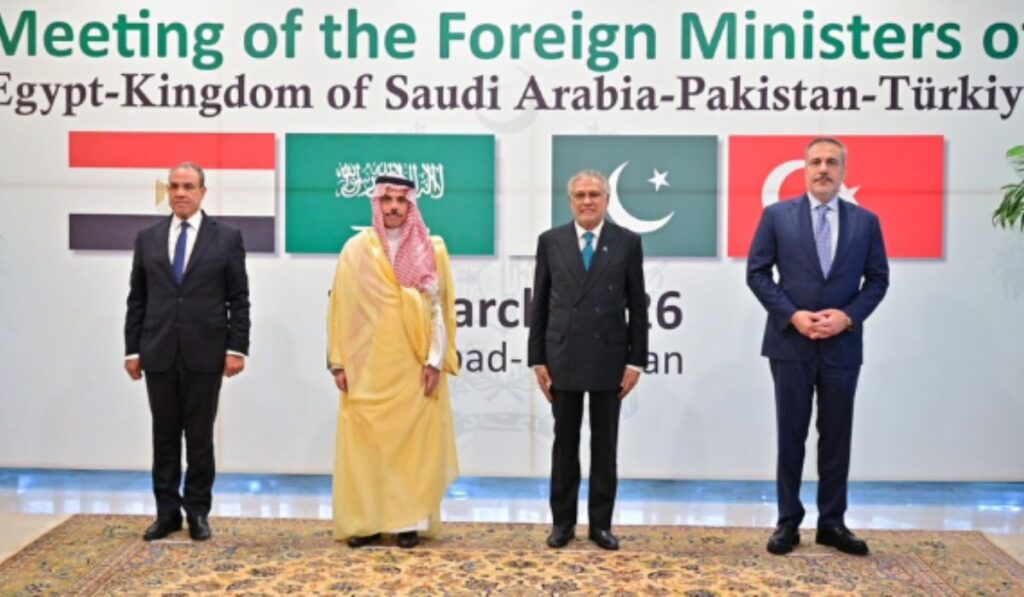
ISLAMABAD: Foreign ministers of Pakistan, Saudi Arabia, Türkiye, and Egypt on Sunday opened Quadrilateral Consultations in Islamabad, signalling renewed efforts to deepen coordination on regional security, economic cooperation, and diplomatic alignment.
The meeting, hosted by Pakistan, brought together senior leadership from Saudi Arabia, Türkiye, and Egypt at a time of shifting geopolitical dynamics across the Middle East and South Asia.
Pakistan’s Foreign Minister Ishaq Dar, addressing the opening session, said the platform reflects a shared commitment to stability, economic integration, and collective responses to emerging global challenges. He emphasised the importance of dialogue among key regional players to address conflicts, promote trade, and strengthen multilateral engagement.
Officials said discussions focused on evolving security situations, including conflicts in the Middle East, maritime security, and counterterrorism cooperation. The ministers also reviewed avenues to enhance trade flows, investment partnerships, and energy collaboration among the four countries.
The Quadrilateral format comes amid increasing economic interdependence between participating nations. Saudi Arabia remains one of Pakistan’s largest sources of remittances and energy supplies, while Türkiye and Egypt have expanded trade and defence ties with Islamabad in recent years. According to Pakistan’s commerce ministry, bilateral trade with these countries has shown steady growth, though it remains below potential.
The talks also took place against the backdrop of broader regional realignments. Saudi Arabia and Türkiye have in recent years sought to normalise relations after a period of tensions, while Egypt continues to play a central diplomatic role in Middle Eastern affairs, particularly in Gaza ceasefire negotiations and Red Sea security.
Diplomatic sources indicated that connectivity initiatives, including transport corridors and logistics cooperation, were also discussed as part of efforts to link South Asia with the Middle East and North Africa more effectively. Energy security featured prominently, with Pakistan exploring long-term supply arrangements and investment opportunities.
The four देशों collectively represent a population of over 500 million and significant economic weight across key regions. Analysts say such platforms can help bridge policy coordination gaps and offer a unified voice on issues affecting the Muslim world and developing economies.
While no joint communiqué was immediately released, officials described the consultations as constructive and forward-looking. Follow-up meetings at technical and ministerial levels are expected to refine proposals discussed during the session.
The Islamabad consultations underline Pakistan’s efforts to reposition itself as a hub for regional diplomacy, leveraging its geographic location and strategic ties. For Pakistan, sustained engagement through such forums could support its broader foreign policy goals of economic diplomacy and regional stability.