 BeNewz
Related Articles
–Foreign ministers meet in Islamabad to push coordinated de-escalation efforts amid rising US-Iran-Israel tensions
—Ishaq Dar held a telephonic conversation with Irani FM, Abbas Araghchi
Aftab Maken
ISLAMABAD: Pakistan on Sunday hosted high-level quadrilateral talks in Islamabad as it stepped up diplomatic efforts to ease escalating tensions in the Middle East involving the United States, Israel, and Iran.
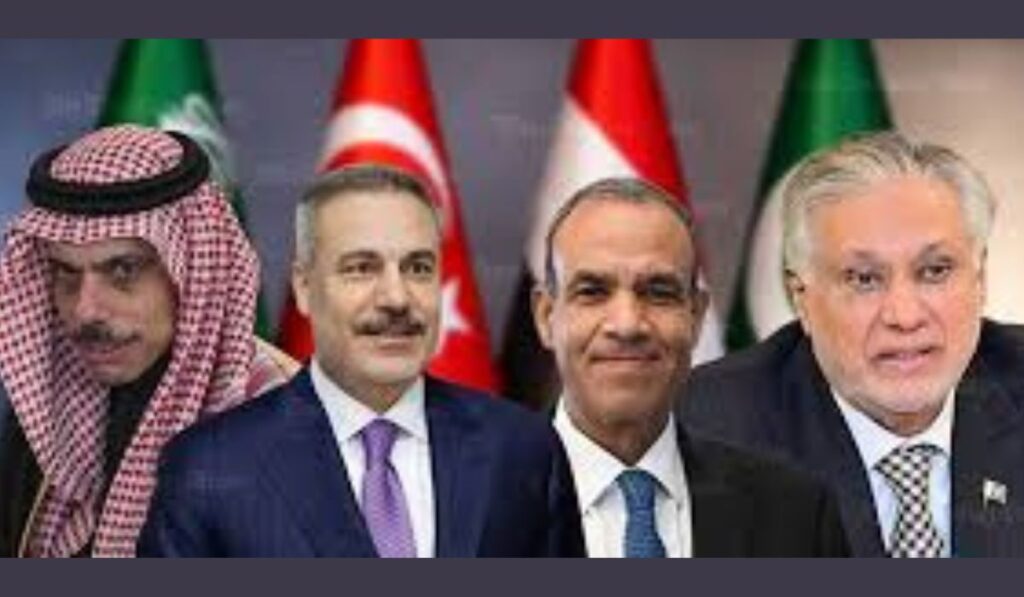
The meeting, chaired by Deputy Prime Minister and Foreign Minister Ishaq Dar, brought together Saudi Foreign Minister Faisal bin Farhan Al Saud, Turkish Foreign Minister Hakan Fidan, and Egyptian Foreign Minister Badr Abdelatty for two days of consultations from March 29 to 30.
Officials said the visiting dignitaries are also scheduled to meet Prime Minister Shehbaz Sharif as Islamabad positions itself as a neutral facilitator in the month-long crisis. Pakistan’s Ministry of Foreign Affairs said the talks aim to explore options for de-escalation and coordinated diplomatic engagement among key regional players.
The initiative comes at a time of heightened volatility in the Middle East, where tensions between Iran and Israel, alongside US involvement, have raised fears of a broader regional conflict. Oil markets have reacted sharply in recent weeks, with Brent crude briefly crossing $95 per barrel, according to data from the International Energy Agency, reflecting concerns over supply disruptions through key transit routes.
Diplomatic sources said Pakistan has quietly played a backchannel role in recent weeks, relaying messages between Washington and Tehran. A reported 15-point proposal from the United States, endorsed by President Donald Trump, has been conveyed to Iranian authorities as part of efforts to revive dialogue. However, Tehran has expressed reservations, viewing some conditions as aligned with US and Israeli strategic interests.
Prime Minister Shehbaz Sharif held a phone conversation with Iranian President Masoud Pezeshkian on Saturday, briefing him on Islamabad’s diplomatic outreach. Iranian officials have indicated that while they remain open to negotiations, any framework must respect sovereignty and regional security concerns.
The Islamabad talks build on earlier consultations among Arab and Islamic countries, including a recent meeting in Riyadh where foreign ministers discussed ceasefire options and humanitarian corridors. According to analysts, Pakistan’s involvement reflects a broader attempt by middle powers to prevent further escalation that could destabilize global energy markets and trade routes.
Pakistan’s diplomatic posture draws on its historical role as a mediator in regional conflicts. Islamabad has previously facilitated dialogue during US-Taliban negotiations leading to the 2020 Doha agreement, demonstrating its ability to engage multiple stakeholders. Analysts say this experience strengthens its credibility in the current crisis.
Economic considerations are also driving urgency. The State Bank of Pakistan has warned that sustained increases in global oil prices could widen the country’s current account deficit, which stood at $0.8 billion in February 2026. Higher import costs may also complicate inflation management, with consumer prices already rising at an annual rate of over 12%, according to the Pakistan Bureau of Statistics.
Türkiye and Saudi Arabia, both key participants in the talks, have significant stakes in regional stability. Saudi Arabia remains the world’s largest oil exporter, while Türkiye serves as a critical transit hub linking Europe and Asia. Egypt’s role as a regional diplomatic heavyweight and custodian of the Suez Canal further underscores the strategic importance of the quadrilateral format.
Turkish Foreign Minister Hakan Fidan said the meeting was initially planned in Ankara but moved to Islamabad following a request from Pakistan due to scheduling considerations. Observers view the shift as a signal of Islamabad’s proactive diplomatic engagement.
No joint statement has been issued so far, with discussions continuing into Monday. Diplomats say any coordinated position on ceasefire mechanisms or confidence-building measures will depend on consensus among participating states and feedback from key stakeholders, including Tehran and Washington.
The outcome of the Islamabad talks could shape broader regional diplomacy in the coming weeks, particularly as global powers weigh options to contain the crisis. Analysts say Pakistan’s ability to maintain neutrality while engaging all sides will be critical in determining whether these efforts translate into tangible de-escalation.
As the situation evolves, Pakistan’s role in facilitating dialogue is likely to remain under close scrutiny, with policymakers and markets watching for signals that could influence both regional stability and global energy dynamics.
Meanwhile, Deputy Prime Minister/Foreign Minister, Senator Mohammad Ishaq Dar held a telephonic conversation with Foreign Minister of Iran, Abbas Araghchi.
The two leaders discussed the evolving regional situation and ongoing developments. DPM/FM emphasized the need for de-escalation, stressing that dialogue and diplomacy remain the only viable path for lasting peace. He also underscored the importance of an end to all attacks and hostilities.
DPM/FM said that Pakistan remains committed to supporting all efforts aimed at restoring regional peace and stability.