 BeNewz
Related Articles



–Balochistan floods kill seven, destroy homes
–Heavy rain and thunderstorms forecast across multiple regions, raising flood and crop damage risks
BeNewz Report
ISLAMABAD: Widespread rain and thunderstorms are expected across Pakistan on Friday as a strong westerly weather system continues to impact upper and central parts of the country, the Met Office said.
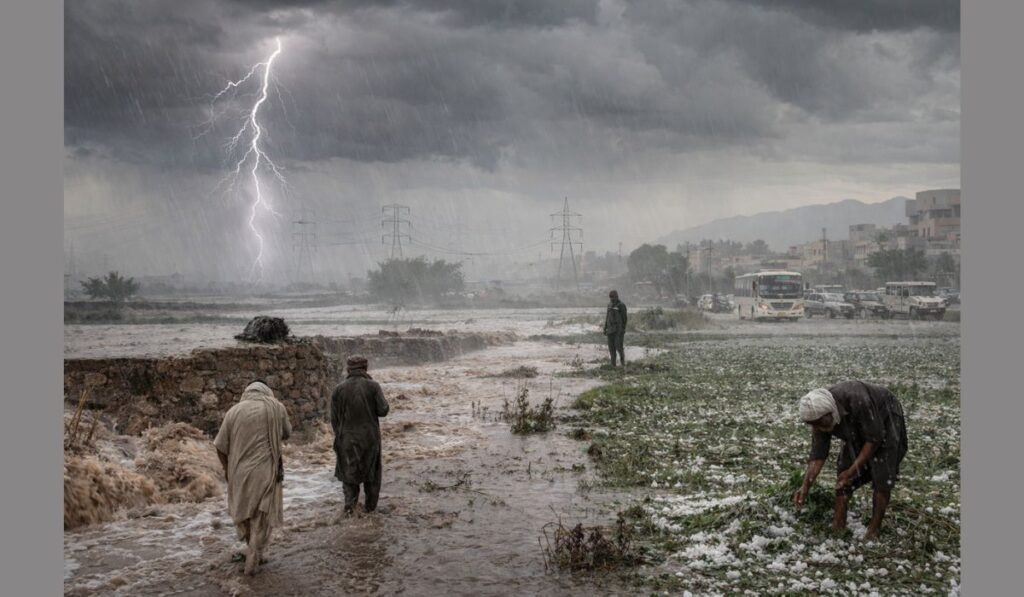
Heavy rain, accompanied by windstorms and isolated hailstorms, is likely in northeastern Balochistan, upper Sindh, Khyber Pakhtunkhwa, Punjab and Kashmir. Officials warned that some areas could receive intense downpours, increasing the risk of flash flooding and infrastructure damage.
The system is also expected to bring thunderstorms with gusty winds to parts of southern and central Balochistan, lower Sindh and GB, although rainfall intensity in these regions is forecast to remain comparatively lower.
Meteorologists said the ongoing weather pattern is being driven by a strong westerly wave, which is expected to persist over upper and central regions until April 4. Such systems typically bring moisture-laden winds, resulting in widespread precipitation and unstable weather conditions.
Authorities have cautioned that heavy rainfall may trigger flash floods in vulnerable areas, particularly in northeastern Balochistan and hilly areas of Khyber Pakhtunkhwa. Local streams and seasonal nullahs could overflow during intense spells, posing risks to nearby settlements.
Strong winds, lightning and hailstorms during this period may also damage weak structures, including electric poles, billboards and solar installations. Farmers have been advised to take precautionary measures, as hailstorms and strong winds could harm standing crops in Punjab, Khyber Pakhtunkhwa and Sindh.
Disaster management authorities remain on alert and have urged residents to avoid unnecessary travel during severe weather and stay updated with official advisories as the siutation develops.
Balochistan floods
Flash floods triggered by heavy rains have killed at least seven people in Balochistan and caused widespread destruction to homes, infrastructure and agriculture, according to the Provincial Disaster Management Authority.
The PDMA said four people were injured while hundreds of houses, livestock and standing crops were destroyed as floodwaters swept through several علاقوں. The worst-hit districts include Harnai, Kohlu, Turbat, Jaffarabad, Loralai, Kachhi, Nasirabad, Jhal Magsi, Dera Bugti, Sibi and Bolan.
An embankment breach in Balanari area of Kachhi caused severe flooding, destroying more than 100 houses and killing over 50 livestock. The report said nearly 400 acres of agricultural land were submerged, raising concerns about food supply and farmer incomes in the areas.
In Harnai and Qila Abdullah, around 100 houses were damaged as heavy rains and flash floods inundated residential areas. Floodwaters also blocked the Gandawah–Notal road in Jhal Magsi, disrupting connectivity and halting traffic flow in the region.
Casualties were reported from multiple districts due to weather-related incidents. Two people died in lightning strikes in Loralai and Kachhi, while one person was killed in Kohlu after a roof collapse. Another fatality occurred in Loralai due to a wall collapse, while a child drowned in Jaffarabad. Two افراد were swept away by floodwaters in Kech district.
The disaster has also severely impacted road infrastructure across the province. Sections of the Harnai–Quetta and Quetta–Sanjawi national highways were washed away, while several internal roads were damaged or rendered unusable. Streams in Harnai and Chaman overflowed, causing flash floods that disrupted daily life and mobility.
According to official data, Balochistan remains highly vulnerable to extreme weather events due to weak drainage systems and scattered settlements. The province has faced repeated climate-related disasters in recent years, including the devastating floods of 2022 that affected millions across Pakistan, as reported by the National Disaster Management Authority.
Agriculture losses are expected to be significant as floodwaters destroyed standing crops, including wheat, chickpeas and mustard. These crops are essential for local food supply and rural livelihoods. Officials said thousands of livestock have also perished, compounding economic losses for farming communities.
Transport and communication links have been badly affected. Roads connecting Notal, Gandawah, Bolan, Yarokazoi and Jhal Magsi have been cut off, isolating several علاقوں and disrupting trade routes between Sindh and Balochistan. The disruption is expected to impact supply chains and increase prices of essential goods in nearby markets.
Rescue and relief operations are underway across affected districts. The PDMA said emergency teams are working with local administrations to assist stranded residents and restore connectivity. Efforts are also ongoing to repair damaged embankments to prevent further flooding.
In Qila Abdullah, a mini-coach carrying 15 women and children was trapped in floodwaters but was safely rescued under the supervision of the Deputy Commissioner with assistance from PDMA teams. Rescue operations are continuing in Goth Taj Habib and Goth Balochani in Kachhi, where authorities are also working to reinforce damaged flood barriers.
Pakistan’s vulnerability to climate shocks has increased in recent years due to changing weather patterns and rising temperatures. According to the Pakistan Meteorological Department, intense rainfall events linked to westerly weather systems have become more frequent, increasing the risk of flash floods in بلوچستان and adjoining regions.
Economists warn that such disasters have long-term implications for rural economies. Damage to crops, livestock and infrastructure reduces incomes and increases dependence on government relief. The World Bank has previously estimated that climate-related disasters cost Pakistan billions of dollars annually in economic losses.
Authorities have urged residents in vulnerable areas to remain cautious and avoid flood-prone areas as more rainfall is expected in coming days. Relief efforts are likely to continue as officials assess the full extent of damage.
The latest floods highlight the growing challenge of climate resilience in Balochistan, where recurring extreme weather events continue to strain infrastructure, agriculture and disaster response capacity.