 BeNewz
Related Articles
–Govt rejects fuel price hike, absorbs Rs56bn burden to shield consumers amid global oil volatility
Aftab Maken
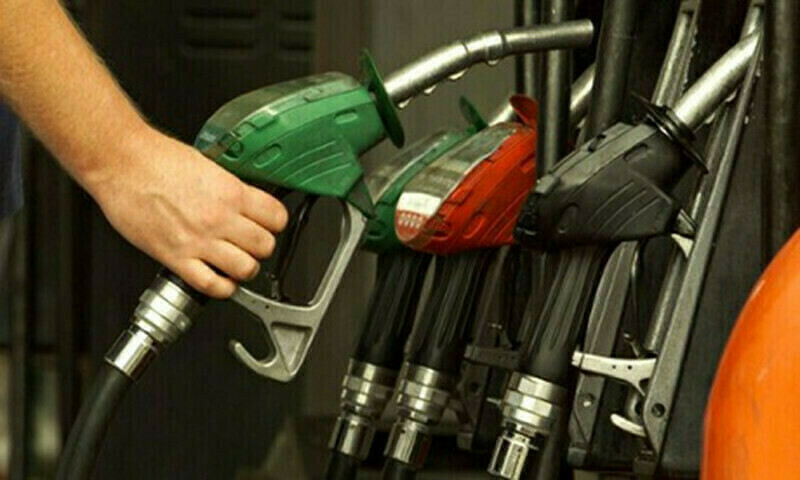
ISLAMABAD: The government has decided to keep petroleum prices unchanged and will bear an additional Rs 56 billion burden, Prime Minister Shehbaz Sharif said in a national address on Friday.
The move follows a recommendation to increase fuel prices, which the government rejected to protect consumers from rising inflation. Authorities will instead compensate oil marketing companies for higher import costs driven by global oil price volatility.
The Ministry of Energy earlier confirmed that petrol will remain at Rs321.17 per litre, while high-speed diesel will stay at Rs335.86 per litre for the current fortnight. The government will provide significant price differentials to offset international price increases.
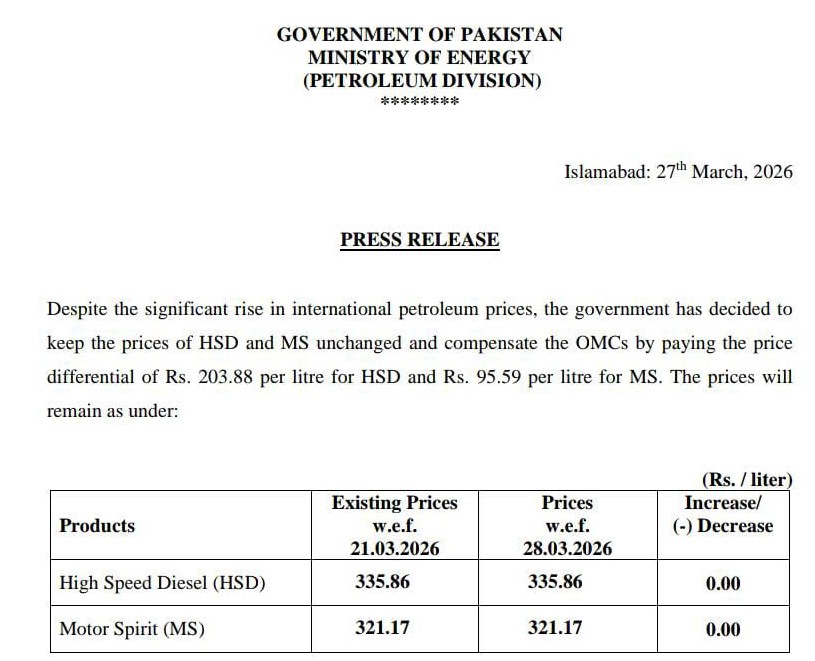
Officials estimate the fiscal impact of the decision at around Rs56 billion, reflecting the widening gap between domestic and global fuel prices. The subsidy aims to prevent immediate pass-through of higher oil costs to transport and food prices, which are highly sensitive to fuel rates.
The decision comes as global crude markets remain volatile, with Brent prices hovering above $80 per barrel in recent weeks. Supply concerns and geopolitical tensions, particularly in the Middle East, have added uncertainty to energy markets.
Pakistan imports a large share of its petroleum requirements, making the economy vulnerable to external price shocks. According to the Pakistan Bureau of Statistics, petroleum imports account for a major portion of the country’s annual import bill, which has exceeded $15–17 billion in recent years.
In his address, the prime minister said the government prioritised public relief despite fiscal constraints. He added that stabilising fuel prices would help contain inflation and support economic recovery momentum.
The decision, however, adds pressure on public finances at a time when Pakistan is implementing reforms under an International Monetary Fund program. The IMF has consistently advised against broad energy subsidies due to their impact on fiscal deficits and resource allocation.
According to the State Bank of Pakistan, energy prices remain a key driver of inflation trends. Although inflation has eased from peaks seen in 2023, it remains sensitive to global commodity price movements.
Pakistan has been following a deregulated fuel pricing mechanism, adjusting domestic prices in line with international trends. However, authorities have occasionally intervened during periods of sharp volatility to cushion consumers and maintain price stability.
The government’s latest move highlights the trade-off between fiscal discipline and inflation control. Analysts warn that prolonged subsidies could strain budget targets, especially as Pakistan aims to reduce its fiscal deficit under IMF commitments.
Energy sector reforms remain central to long-term stability. The government is working to reduce circular debt, improve efficiency in distribution, and encourage private sector participation in the power and petroleum sectors.
Looking ahead, fuel pricing decisions will depend on global oil trends, exchange rate stability, and fiscal space. Sustained high international prices could complicate Pakistan’s reform path and budget management in the coming months, keeping Pakistan’s fuel policy under close scrutiny.