 BeNewz
Related Articles



Aftab Maken
ISLAMABAD: A Qatari liquefied natural gas (LNG) tanker is moving through the Strait of Hormuz toward Pakistan, offering potential relief to the country’s worsening gas supply crunch amid regional tensions linked to the Iran conflict.
Shipping data showed the LNG carrier “Al Kharaitiyat” proceeding at full speed toward Pakistan with no indication of altering its route. If completed successfully, the delivery would mark the first LNG export from Qatar through the Strait of Hormuz since hostilities in the Middle East escalated in late February 2026.
Pakistan has been facing mounting pressure on gas supplies after disruptions to Qatari LNG cargo movements earlier this year. Qatar remains Pakistan’s largest LNG supplier under long-term agreements, and interruptions in shipments forced Islamabad to explore spot market purchases to bridge supply gaps.
In a parallel development, Pakistan LNG Limited (PLL) issued a fresh international tender seeking bids for two spot LNG cargoes for May delivery at Port Qasim, Karachi. The procurement has been launched under Tender No. PLL/IMP/LNGT65 on a delivered ex-ship (DES) basis.
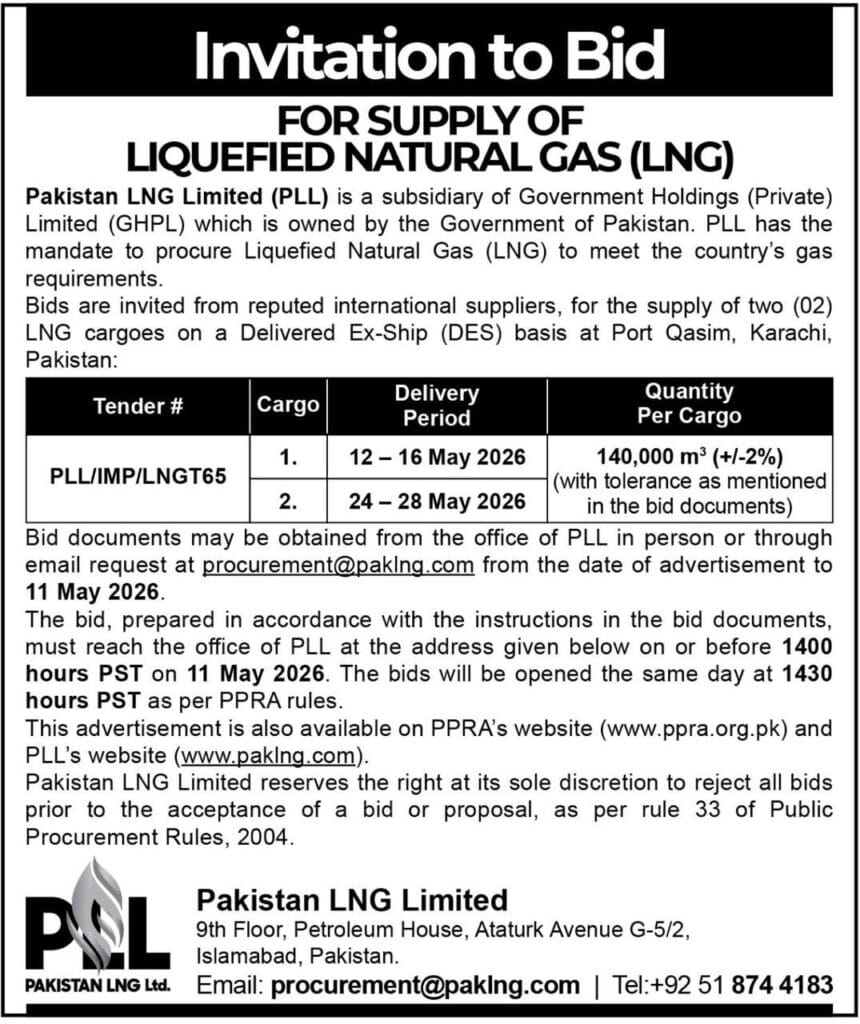
According to the tender documents, the first cargo of around 140,000 cubic metres is required for delivery between May 12 and 16, while the second cargo of the same quantity is scheduled for delivery between May 24 and 28.
PLL said bids must be submitted by 1400 PST on May 11, with bid opening scheduled for 1430 PST the same day. The bidding process comes just days after Pakistan rejected earlier LNG offers from BP Singapore and TotalEnergies, which were considered expensive amid volatile global energy markets.
Energy analysts said the safe transit of the Al Kharaitiyat could help stabilize Pakistan’s immediate LNG supply situation and potentially reduce dependence on costly spot purchases. However, uncertainty surrounding the Strait of Hormuz continues to keep global LNG markets on edge.
The Strait of Hormuz handles nearly one-fifth of global oil and gas trade during normal conditions, making it one of the world’s most strategically sensitive energy routes. Any disruption in the passage has immediate implications for LNG-importing countries, including Pakistan, Bangladesh, and several European states.
Pakistan’s LNG demand typically rises during peak summer months due to increased electricity generation requirements. The country imports LNG mainly through long-term contracts with Qatar, while additional spot cargoes are purchased during supply shortfalls or seasonal demand spikes.
Industry observers said Islamabad’s latest procurement move reflects concerns over supply security despite expectations of easing geopolitical tensions. They noted that continued uncertainty in the Middle East could push LNG spot prices higher and intensify competition among Asian buyers.
Pakistan’s energy sector is already under pressure from rising import costs, circular debt, and foreign exchange constraints. The government has recently increased petroleum prices and adjusted domestic energy tariffs under commitments linked to the International Monetary Fund’s reform programme.
Market participants are now closely watching whether the successful arrival of the Qatari cargo will influence PLL’s decision on proceeding with the newly floated spot tender. Analysts believe Pakistan may still seek additional cargoes to build supply buffers against further regional disruptions.