 BeNewz
Related Articles

BeNewz Report
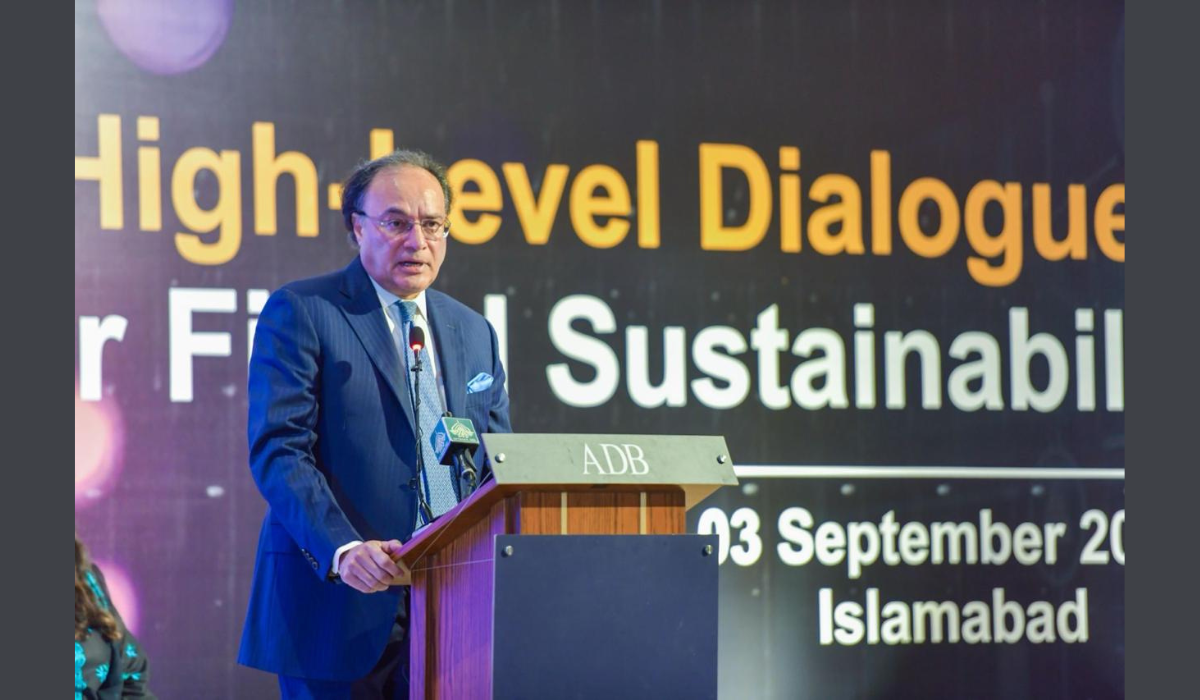
ISLAMABAD: Federal Finance Minister Muhammad Aurangzeb has said the government is pursuing comprehensive tax reforms and steadily expanding the tax net, even as Pakistan achieves a milestone in international capital markets.
Addressing a high-level international dialogue on taxation for fiscal sustainability, organized by the Asian Development Bank (ADB) in Islamabad, Aurangzeb announced that Pakistan has issued a $3 billion dual-tranche Eurobond, describing it as the largest bond transaction in the country’s history.
Background: Reforms, Tax Collection and Eurobond Details
Aurangzeb said the tax reforms have led to a marked improvement in tax collection, with practical steps underway to curb the undocumented economy. He noted that raising the tax-to-GDP ratio remains the government’s top priority, revealing that the ratio has already climbed from 8.1 percent to 10.3 percent — though he stressed there is “more to do” on this front.
On the Eurobond, the finance minister was emphatic that the issuance was neither a temporary nor a sudden decision, but part of a three-year medium-term Global Medium Term Note (GMTN) strategy.
According to the Ministry of Finance and international media reports, the transaction attracted nearly $6 billion in orders — almost twice the amount issued — from a broad and diversified base of institutional investors spanning Asia, the Middle East, Europe and the United States.
The offering comprised $1.75 billion through a 5.5-year Eurobond at a 7.50 percent coupon, and $1.25 billion through a 10-year Eurobond at a 7.90 percent coupon. Proceeds are expected to go toward meeting external financing needs, including the repayment of older debt.
Aurangzeb said Pakistan’s credit rating has been upgraded three times since April 2025, and that the diversified investor participation reflects renewed international confidence — not just in the country’s present economic situation, but in its future trajectory. He added that the government is also exploring Sukuks, rupee-denominated dollar-settled bonds, and Panda Bonds as part of its broader market-access strategy.
Separately, FBR Chairman Rashid Mahmood Langrial told the same event that “fundamentally game-changing reforms” had been undertaken at the FBR over the past two and a half years, including welcoming private-sector expertise, bringing in third-party auditors, and preparing to launch IRIS 3.0. Minister of State for Finance Bilal Azhar Kayani also addressed the gathering, calling domestic resource mobilization a “critical national and fiscal priority.”
Social Media and Public Reaction
Reaction to the announcement has been mixed across Pakistani media and online commentary:
- Official channels and mainstream outlets amplified the Finance Ministry’s framing of the deal as a “landmark moment” in Pakistan’s return to international capital markets, with several outlets highlighting the nearly $6 billion in orders as a sign of strong demand.
- Some economic commentators questioned the underlying dynamic, noting that a portion of the new borrowing will go toward repaying older debt — renewing debate over Pakistan’s cycle of raising fresh loans to service existing obligations.
- Others flagged the 7.50–7.90 percent coupon rates as relatively high compared to global benchmarks, though government-aligned voices countered that the pricing was competitive given prevailing market conditions and Pakistan’s risk profile.
- A more optimistic strand of reaction framed the deal, together with the tax reform push, as confirmation that Pakistan’s post-IMF stabilization efforts are translating into tangible market confidence, particularly given the strong demand for the longer 10-year tranche.
Expert Analysis
Financial analysts note that demand nearly double the amount offered signals that institutional investors are increasingly confident in Pakistan’s macroeconomic stabilization, improving credit profile, and ongoing tax reform trajectory. The relatively strong appetite for the 10-year tranche is seen as particularly significant, given that Pakistan has historically struggled to attract long-tenor financing.
Analysts also point out that this marks the first issuance under Pakistan’s renewed GMTN program following the country’s inaugural Panda Bond, and that the strategy is intended to diversify funding sources, extend debt maturities, and reduce refinancing and rollover risk — rather than simply adding to the debt stock.
Even so, some caution that the real test will be whether tax reforms and fiscal discipline keep pace, so that Pakistan can reduce its reliance on repeated international borrowing over time. The Finance Ministry itself has acknowledged the reform process remains incomplete, citing continued work needed on fiscal discipline, structural reforms, export competitiveness, investment and productivity.