 BeNewz
Related Articles


Aftab Maken
ISLAMABAD: Pakistan’s FM radio industry is grappling with a structural crisis that stakeholders describe as the near-total absence of an economy of scale for sustainability, compounded by a regulatory environment in which non-licensed operators reportedly wield greater practical influence over the airwaves than the Pakistan Electronic Media Regulatory Authority (PEMRA) itself. Industry insiders and media analysts say the situation reflects a deeper institutional failure, one in which the regulator lacks the technical capacity to enforce the community service commitments made by licensees, while penalties and rewards under existing regulations remain toothless. The cost, they warn, is not borne by broadcasters alone. It is borne by audiences, and increasingly by a young generation that has quietly given up on regulated media altogether.
A Regulator Outmatched by the Market It Oversees
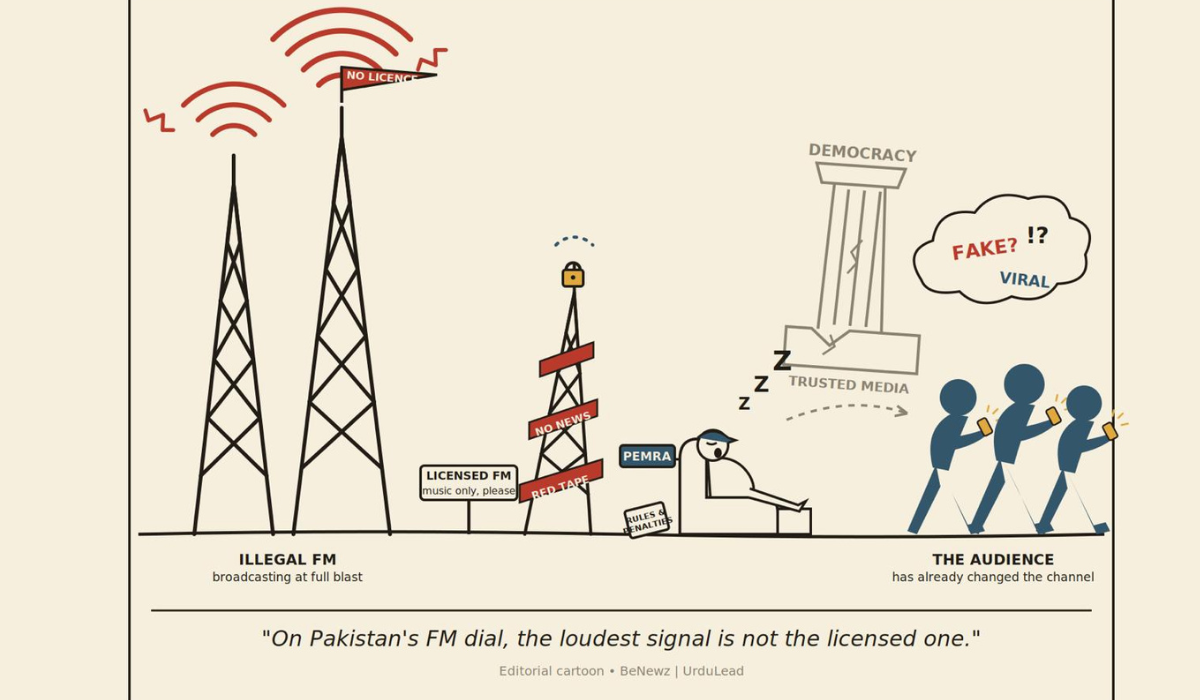
According to broadcasters and sector analysts, the FM radio market in Pakistan has been distorted by the persistent operation of non-licensee stations alongside legally licensed broadcasters, a dynamic that undercuts fair competition and denies compliant operators the economies of scale needed to remain commercially viable. PEMRA‘s own historical record acknowledges the scale of the problem. The regulator has periodically reported dozens to over a hundred illegal FM stations operating in various regions, particularly in tribal and border areas, with officials repeatedly citing shortages of field staff and enforcement capacity as the reason such operations persist despite periodic crackdowns.
Stakeholders argue that when non-licensees can broadcast with fewer compliance costs and little fear of consequence, they effectively out-compete legitimate license holders, a reversal of the regulatory hierarchy that critics describe as “non-licensees more powerful than the regulator.” This is compounded, they say, by what industry circles refer to as “ghost bidding” in FM license auctions, a practice broadcasters allege undermines transparent frequency allocation and distorts the market before stations even go on air.
A further concern raised by industry voices is PEMRA’s limited technical expertise to oversee the community service obligations that FM licensees pledge to fulfill as a condition of their licenses. Analysts note that while licenses are awarded on the premise of serving local community information needs, PEMRA has historically restricted FM stations from carrying meaningful news and current affairs content, including a 2012 amendment that removed provisions allowing local news programming. This leaves the regulator with little practical mechanism to assess whether licensees are meeting the very pledges their licenses were built on.
Compounding this, stakeholders point to the absence of any structured reward and penalty mechanism within the existing regulatory framework. There is no formal system to recognize and incentivize compliant, community-oriented broadcasters, nor a calibrated penalty structure to meaningfully deter non-compliance or illegal operations.
The Audience Pays the Price
The most consequential casualty of this stalemate, analysts say, is the listener. When licensed stations are commercially squeezed into playing safe with wall-to-wall music, and barred in practice from serious local news, communities lose the one medium that was designed to speak to them in their own language, about their own streets, schools, water supply and local governance. FM radio remains one of the cheapest and most accessible information channels in Pakistan, reaching households and vehicles where broadband is patchy and television is centralized around national politics. A regulatory framework that hollows out its public service function does not merely weaken an industry. It leaves millions of citizens without a trusted local information source at precisely the moment they need one.
The gap has not stayed empty. It has been filled by social media, and nowhere more completely than among the young. Pakistan’s population is overwhelmingly youthful, and this generation’s information diet now runs through TikTok, YouTube, WhatsApp forwards and X threads rather than any regulated broadcaster. The platforms offer immediacy and voice, but they come with no editorial gatekeeping, no verification culture and no accountability when falsehoods spread. Young Pakistanis are forming their views on elections, religion, health and national security in an environment where a doctored clip travels faster than any correction, and where the loudest account, not the most accurate one, wins the argument.
Media scholars describe this as a democratic risk, not just a media market problem. Democracies depend on a shared baseline of verified fact, on institutions that citizens can hold accountable when they get things wrong, and on local journalism that surfaces problems before they become crises. When trusted media weakens, that baseline erodes. Rumor fills the space where reporting should be, polarization deepens because communities no longer share common facts, and voters, especially first-time young voters, become easier targets for coordinated disinformation. An FM sector that could have anchored local, verified, accountable information for a digital-first generation has instead been regulated into irrelevance, while unregulated spaces set the national conversation.
The irony, stakeholders note, is that illegal FM stations have historically demonstrated exactly how powerful the medium can be when used without restraint, including its documented use for extremist messaging in some regions. The lesson drawn by the state was to restrict licensed broadcasters further, rather than to empower them as a credible counterweight.
Industry and Public Reaction
Reaction from the broadcast community has centered on frustration with the status quo. Independent FM operators describe survival, not growth or public interest journalism, as the industry’s primary preoccupation, with only bare-bones music formats or stations backed by large media houses seen as durable. Media commentators have renewed calls for PEMRA to publish transparent data on license bidding, specifically addressing allegations of ghost bids. Broadcasting voices question why, despite PEMRA’s own acknowledgment of illegal FM proliferation, no durable structural fix has been institutionalized beyond periodic raids. Journalism advocates flag the continued absence of genuine news space on FM as a missed opportunity for local information diversity.
Expert Analysis
Media policy analysts argue that the coexistence of licensed and non-licensed operators in the same market represents a fundamental regulatory failure rather than a peripheral enforcement gap. Without consistent, resourced enforcement, compliant broadcasters are structurally disadvantaged, undermining the economies of scale smaller independent stations need to survive. Analysts add that PEMRA’s dual role as frequency regulator and content authority requires specialized broadcast and community media expertise that has not been consistently reflected in its staffing or leadership. Absent a functioning reward and penalty framework, and absent a deliberate strategy to rebuild audience trust before an entire generation stops listening, experts warn the sector risks permanent stagnation, with journalism development on FM radio remaining an unmet promise and Pakistan’s democratic information space left to the platforms least equipped to protect it.