 BeNewz
Related Articles



–Boards warn crackdown as students chase shortcuts ahead of exams
BeNewz Report
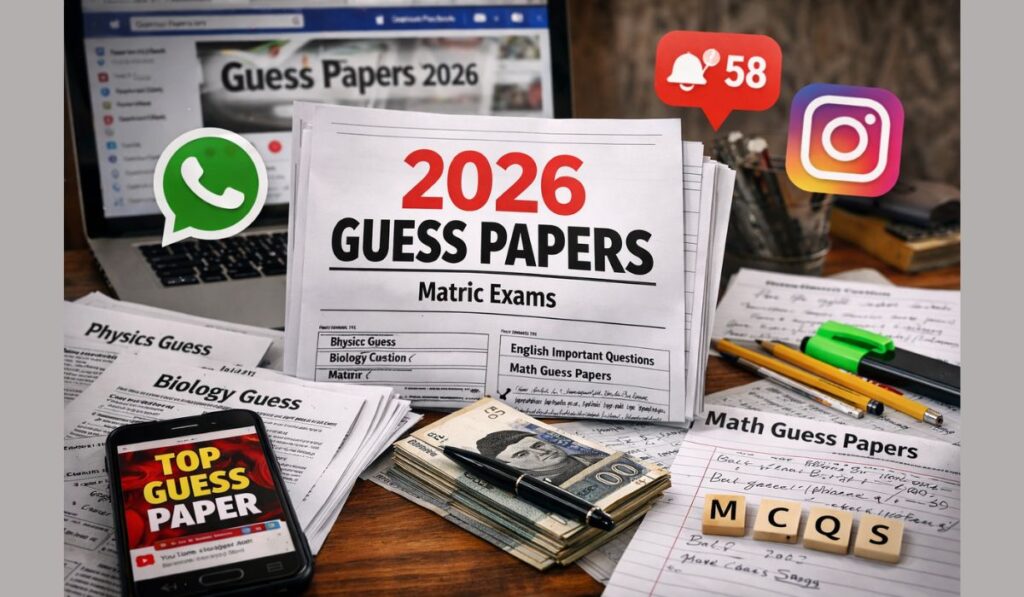
LAHORE: Social media platforms in Pakistan have been flooded with guess papers as Matric 2026 board examinations approach, raising concerns among education authorities about academic integrity and declining learning standards.
In recent weeks, Facebook, Instagram, WhatsApp groups, and YouTube channels have seen a surge in posts offering subject-wise guess papers for key subjects, including English, Physics, Chemistry, Mathematics, Pakistan Studies, and Biology. Many of these posts claim that up to 90% of exam questions will come from the shared material.
The content is being widely circulated by teachers, coaching centres, and private academies seeking to attract students ahead of the annual examinations. Some providers are offering free PDF downloads through messaging apps, while others are charging nominal fees for “complete guess bundles” or “high-target” versions tailored to specific boards.
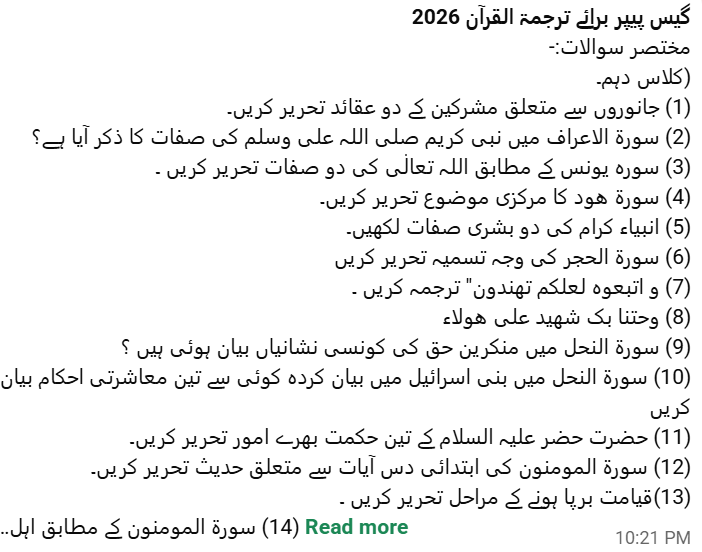
These materials are often compiled using past examination papers, official pairing schemes, and frequently repeated questions. For many students, especially those under time pressure, guess papers serve as a quick revision tool, particularly for objective sections and short questions.
However, education experts warn that the growing dependence on such material is undermining conceptual learning. They say students are increasingly relying on selective preparation instead of covering the full syllabus, which weakens analytical skills and subject understanding.
Punjab’s education boards have taken notice of the trend. Authorities including the Board of Intermediate and Secondary Education Lahore and other regional boards have issued directives banning the sharing of guess papers, pairing schemes, and past papers on social media platforms.
According to official communications sent to schools, teachers and administrators have been instructed not to operate or participate in such online groups. The boards have warned that violations could lead to legal action under cybercrime laws, including fines and possible imprisonment.
Despite these measures, the circulation of guess papers continues largely unchecked. Analysts attribute this to strong student demand as well as the commercial incentives for content creators, who gain online engagement and promote their tuition services through such material.
Critics argue that many of these guess papers lack credibility and are often recycled versions of older exam questions with little predictive accuracy. However, anecdotal evidence from students suggests that certain portions, particularly multiple-choice questions, have matched actual exams in previous years, reinforcing trust in such resources.
Pakistan’s Matriculation examinations are a critical academic milestone, with millions of students appearing each year. In Punjab alone, more than two million candidates typically sit for these exams annually, according to official education department estimates. The intense competition and pressure to secure high marks have contributed to the popularity of shortcut-based preparation methods.
Historically, the use of guess papers is not new in Pakistan’s education system. However, the scale and speed of their dissemination have increased significantly with the rise of digital platforms and smartphone access. Over the past decade, social media has transformed exam preparation trends, making unverified content more accessible than ever.
Recent education policy discussions have also highlighted concerns about rote learning and exam-centric preparation. The Single National Curriculum initiative and ongoing assessment reforms aim to promote conceptual understanding, but implementation challenges remain.
Educationists recommend that students prioritize official textbooks, board-prescribed syllabi, and authentic past papers for effective preparation. They emphasize that guess papers should only be used as supplementary tools for revision rather than primary study material.
With examinations expected to take place after Ramadan and Eid in many regions, academic pressure is intensifying. Parents and teachers are being urged to guide students towards structured study plans instead of relying on unverified online content.
The effectiveness of the boards’ crackdown on guess papers remains uncertain. For now, social media feeds continue to be dominated by “2026 guess paper” posts, reflecting a broader challenge within Pakistan’s examination system.
As Matric 2026 exams draw closer, the reliance on guess papers underscores the need for stronger regulation, improved teaching standards, and greater awareness about sustainable learning practices. Whether authorities can curb this trend will be closely watched in the coming weeks as students prepare for one of the most important exams of their academic journey.