 BeNewz
Related Articles



Islamabad court convicts Bahria Town executive Khalil ur Rehman in a Rs 1.6bn money laundering case, imposing a 10-year sentence and Rs25m fine in a major FIA prosecution

Aftab Maken
ISLAMABAD: An Islamabad court sentenced Bahria Town executive Khalil ur Rehman to 10 years imprisonment in a major money laundering case on Saturday. The Additional Sessions Court also imposed a Rs25m fine after convicting him of laundering billions of rupees through illegal channels.
Additional Sessions Judge Nasrumminallah Baloch announced the verdict in Islamabad on March 7. The court found Khalil ur Rehman guilty under Sections 3 and 4 of the Anti-Money Laundering Act, 2010. The case relates to FIR No.19/2025 registered by the Federal Investigation Agency’s Anti-Money Laundering Circle.
Court records show the accused laundered about Rs1.6bn through complex financial transactions. Prosecutors alleged the transfers occurred through informal hawala and hundi networks. These transactions allegedly began as early as 2007 and continued over several years.
Investigators said the funds were moved abroad through unregulated channels. Authorities claimed the money was later used to acquire foreign properties and assets. Prosecutors argued that layered transactions helped conceal the origin of the funds.
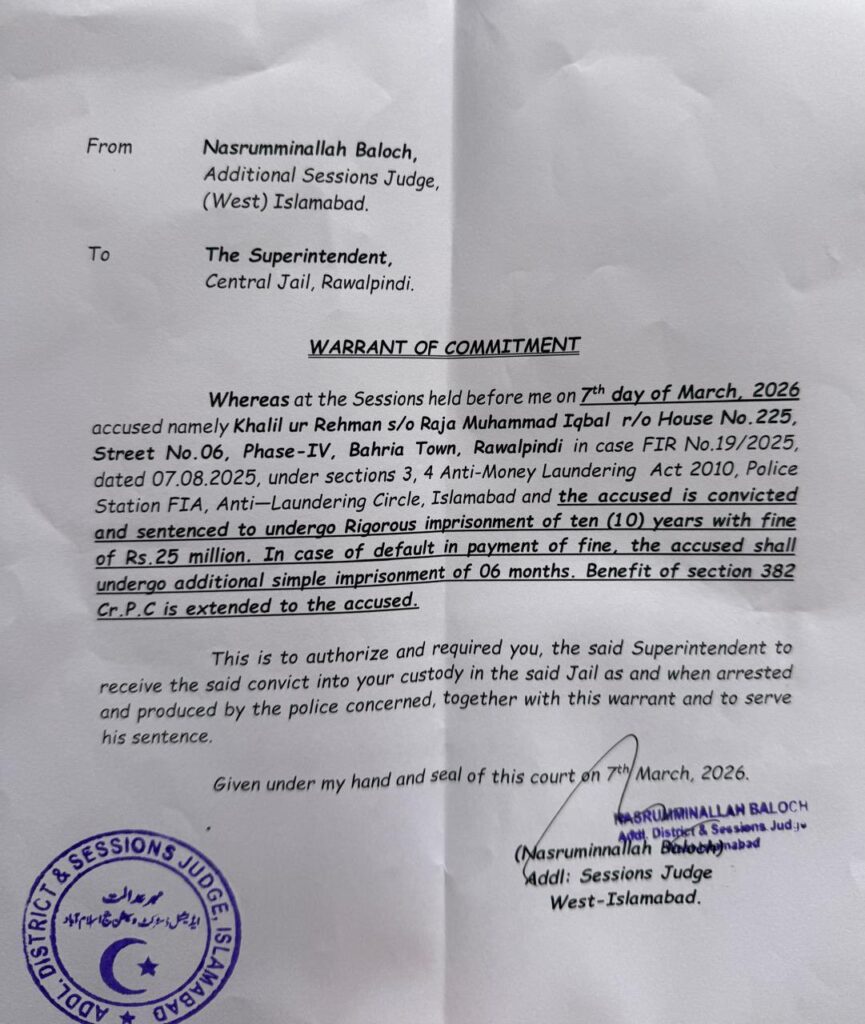
The court’s warrant of commitment directed Central Jail Rawalpindi authorities to take custody immediately. If the Rs25m fine remains unpaid, the convict will serve six additional months imprisonment. The court granted procedural considerations under Section 382 of the Code of Criminal Procedure.
Khalil ur Rehman previously served as Vice Chief Executive of Bahria Town Limited. The company is one of Pakistan’s largest private real estate developers. It was founded by property tycoon Malik Riaz Hussain and operates large housing projects nationwide.
The FIA has intensified scrutiny of financial crimes linked to real estate development. According to the agency’s annual enforcement data, several anti-money laundering investigations were launched during 2024 and 2025. These probes focused on suspected capital flight and undocumented property transactions.
Pakistan strengthened its anti-money laundering laws after international pressure to curb illicit financial flows. The Anti-Money Laundering Act was enacted in 2010 and amended multiple times. The reforms aimed to align domestic regulations with global Financial Action Task Force standards.
The State Bank of Pakistan has also tightened monitoring of cross-border financial transactions. Banks must report suspicious transactions through the Financial Monitoring Unit under national AML regulations. According to official policy statements, these measures seek to reduce illegal capital outflows and tax evasion.
Pakistan’s real estate sector has long faced regulatory scrutiny due to large undocumented cash transactions. Industry analysts estimate the sector contributes nearly 2% of the country’s gross domestic product. However, authorities believe the sector historically facilitated unreported wealth transfers and asset concealment.
The government introduced new property valuation rules and reporting requirements in recent years. These reforms were aimed at increasing transparency in land transactions. Tax authorities also began linking property records with financial disclosures to discourage illicit investments.
The Bahria Town case forms part of wider investigations into alleged financial irregularities linked to overseas property transfers. Earlier court proceedings distributed charge sheets to several accused individuals. Some suspects, including Malik Riaz and his son Ali Riaz, were declared proclaimed offenders in related cases.
Legal experts say the conviction signals tougher enforcement against white-collar crime. Prosecutors increasingly rely on financial trails and banking records to establish laundering schemes. Courts have also begun imposing stronger sentences to deter large-scale economic offenses.
Analysts believe appeals are likely in the case through higher courts. However, the conviction underscores growing judicial scrutiny of high-profile financial crimes. The verdict also reflects broader government efforts to strengthen anti-money laundering enforcement across Pakistan’s real estate sector.