 BeNewz
Related Articles



Aftab Maken
ISLAMABAD: Pakistan’s short-term inflation registered a slight increase in the latest week, driven mainly by higher prices of vegetables and fuel, according to official data released on Thursday.
The Sensitive Price Indicator (SPI) — a weekly gauge of price movements for 51 essential commodities across 50 markets in 17 cities — rose by 0.09% during the week ended February 4, 2026, data from the Pakistan Bureau of Statistics (PBS) showed. The marginal uptick comes after a 0.03% decline recorded in the previous week ended January 29.
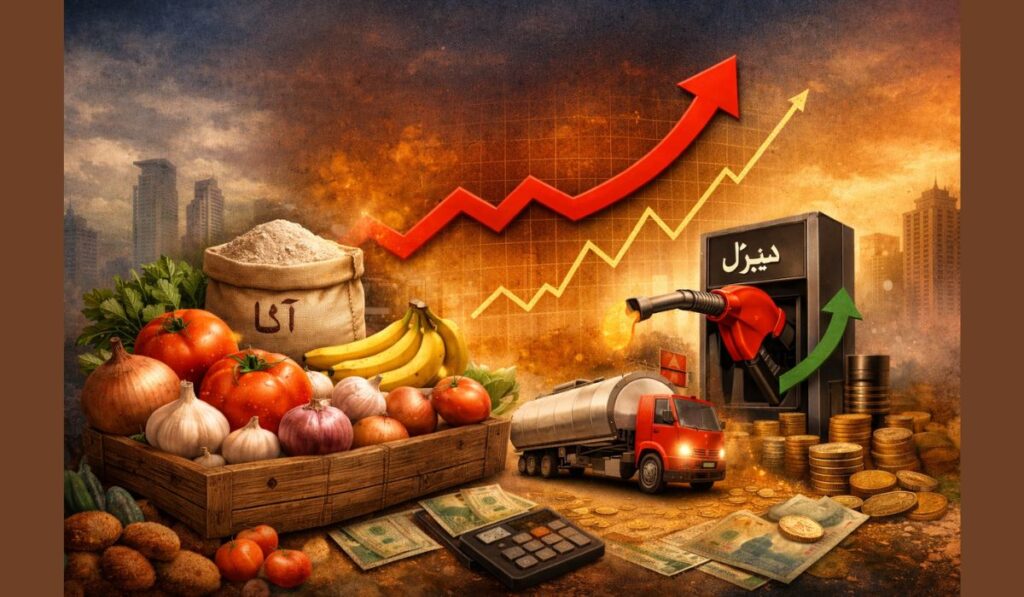
The weekly increase was largely attributed to sharp jumps in key food items. Tomato prices surged 12.78%, followed by bananas (8.16%), onions (7.27%), garlic (5.45%), and diesel (4.35%). Moderate increases were also observed in pulse mash (2.34%), pulse moong (0.35%), mustard oil (0.30%), and mutton (0.24%).
However, price declines in several staple items helped offset some of the inflationary pressure. Wheat flour prices fell by 2.89%, while eggs declined 2.86%. Other items registering weekly decreases included pulse masoor (1.26%), liquefied petroleum gas (LPG) at 0.88%, gur (0.73%), salt powder (0.59%), pulse gram (0.58%), cooking oil in 5-litre packs (0.52%), and IRRI-6/9 rice (0.36%).
Overall, out of the 51 commodities tracked under the SPI, prices increased for 12 items (23.53%), declined for 13 items (25.49%), while 26 items (50.98%) remained unchanged during the week.
On a year-on-year basis, the SPI rose 4.84%, highlighting continued price pressures on certain essential goods despite easing trends in others. Major annual increases were recorded in tomatoes (79.70%), eggs (38.87%), wheat flour (34.69%), gas charges for the first quarter (29.85%), bananas (13.49%), chili powder (13.30%), beef (12.65%), LPG (11.53%), firewood (11.28%), powdered milk (9.92%), shirting (8.49%), and gur (8.45%).
In contrast, significant year-on-year price reductions were noted in potatoes (44.14%), garlic (32.69%), pulse gram (25.30%), onions (23.03%), Tea Lipton (17.79%), chicken (11.64%), salt powder (10.68%), pulse masoor (10.36%), and petrol (1.33%).
The latest SPI reading aligns with broader inflation trends. Headline consumer price inflation, measured by the Consumer Price Index (CPI), rose to 5.8% year-on-year in January 2026, up from 5.6% in December, remaining within the government’s 5–7% target range. Economists view the SPI as an early indicator of inflationary pressures, particularly for lower- and middle-income households that are most affected by fluctuations in essential commodity prices.