 BeNewz
Related Articles



Aftab Maken
ISLAMABAD: In a modest relief for inflation-weary consumers, Pakistan’s Sensitive Price Indicator (SPI) edged down by 0.03% for the week ending January 29, 2026, according to the latest report from the Pakistan Bureau of Statistics (PBS).
This weekly gauge, tracking 51 essential commodities across 50 markets in 17 cities, signals short-term price shifts in everyday staples. Yet, beneath the slim decline lies a volatile mix of sharp drops in some vegetables and stubborn rises in others, underscoring persistent food inflation pressures in a nation grappling with economic headwinds.
The weekly snapshot reveals a tale of two markets. Potatoes led the plunge with a hefty 7.81% drop, followed by onions at 6.66%, offering some respite to household budgets strained by prior spikes. Salt powder fell 1.36%, wheat flour 1.17%, and smaller dips hit pulse masoor (0.75%), eggs (0.30%), gur (0.24%), and broken basmati rice (0.08%). These declines spanned nine items, or 17.65% of the basket, hinting at seasonal gluts or improved supply chains for root crops.
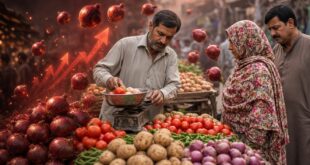
Conversely, tomatoes rocketed 7.53%, chicken climbed 3.25%, and bananas rose 3.07%, amplifying grocery bills for protein and fruit-dependent families. LPG surged 1.56%, pulse mash 1.49%, pulse gram 1.31%, chilies powder 0.66%, and pulse moong 0.61%. Firewood, vegetable ghee (2.5kg), shirting, and cigarettes saw milder upticks of 0.24% to 0.37%. Overall, 18 items (35.29%) increased, 24 (47.06%) held steady—leaving stability as the dominant but uncelebrated force.
Critically, this micro-decline masks deeper systemic woes. While weekly SPI offers a pulse-check, the year-on-year (YoY) trend paints a grimmer picture: a 4.52% inflation creep. Eggs have ballooned 42.85%, tomatoes 41.14%, and wheat flour 38.29%—essentials that hit the poor hardest. Gas charges for Q1 jumped 29.85%, chilies powder 13.30%, beef 12.65%, firewood 11.54%, and LPG 11.31%. Powdered milk (10%), gur (9.25%), shirting (8.49%), and bananas (8.33%) also swelled.
Bright spots in YoY? Potatoes crashed 47.35%, garlic 35.89%, onions 31.40%, and pulse gram 26.16%. Tea Lipton eased 17.79%, chicken 14.88%, pulse mash 10.94%, salt powder 9.80%, diesel 1.27%, and petrol 0.95%. These reversals likely stem from bumper harvests or import tweaks, but they do little to offset broader gains.
Economists caution against complacency. The SPI’s narrow 0.03% dip—barely a rounding error—reflects no structural fix amid currency woes, flood aftermaths, and global commodity shocks. Food items, weighting heavily in the basket, drive volatility: tomatoes’ weekly spike erases potato gains for many shoppers. With 35% of items rising and YoY at 4.52%, real purchasing power erodes, especially for low-income households where staples consume 60% of budgets.
Government interventions—like subsidies on wheat or LPG caps—have yielded mixed results, as evidenced by flour’s dual trends (weekly down, YoY up). Critics argue PBS data, while rigorous, underplays rural-urban divides; the 17-city focus misses remote areas where transport hikes amplify costs.
As Pakistan navigates fiscal tightening and IMF talks, this SPI hints at fragile stability. A true downturn demands supply-side reforms: better cold storage for perishables, import diversification, and anti-hoarding enforcement. For now, consumers brace for the next swing—will tomatoes cool or potatoes rebound? The weekly ritual continues, a barometer of resilience in uncertain times.