 BeNewz
Related Articles



Despite federal approval to eliminate circular debt in June, the power sector’s debt climbed to Rs1.661 trillion in July 2025.
Aftab Maken
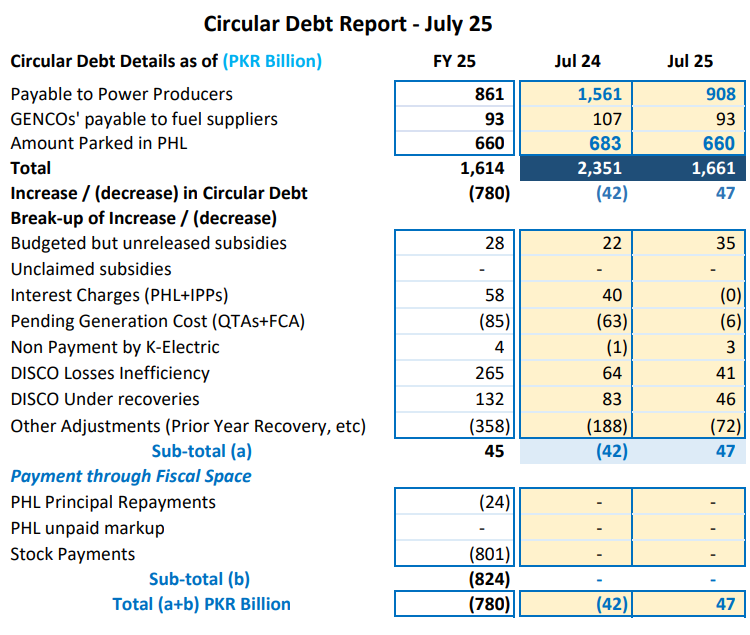
In a setback to the government’s financial reform drive, Pakistan’s power sector circular debt rose by Rs47 billion in July 2025, just weeks after a high-level decision to eliminate it. According to internal documents from the Power Division, the total circular debt increased to Rs1.661 trillion by the end of July, compared to Rs1.614 trillion in June 2025.
This monthly increase comes in the wake of a major federal decision on June 18, when Prime Minister Shehbaz Sharif chaired a cabinet meeting that approved borrowing Rs1.275 trillion from commercial banks to retire circular debt. At the time, the government projected this move as a milestone toward stabilizing the power sector and improving energy supply.
The Power Division’s data also reveals a broader year-on-year decline. As of July 2024, the total circular debt stood at Rs2.351 trillion. That figure has dropped by Rs737 billion over the past 12 months, suggesting partial success in long-term debt reduction. However, the month-on-month rise signals persistent structural weaknesses in Pakistan’s energy sector.
Circular debt refers to the unpaid dues that pile up across the power supply chain — from electricity producers to distributors — largely due to non-payment by consumers, delays in government subsidies, and technical inefficiencies such as line losses. This systemic imbalance eventually affects electricity generation and the national power supply.
Analysts have expressed concern that despite the significant injection of funds in June, the underlying issues driving debt accumulation remain unaddressed. These include poor recovery of electricity bills, transmission losses, underperforming distribution companies (DISCOs), and delays in subsidy payments by the government.
Energy economists have warned that without structural reforms, such as tariff rationalization, efficiency upgrades in DISCOs, and transparent subsidy disbursement, the debt will likely resurface — as it has after similar bailouts in the past.
The last major attempt to wipe out circular debt occurred in 2013 under the PML-N government, which cleared Rs480 billion in one go. Yet, the debt re-emerged within two years due to unchanged inefficiencies. The recent increase in July 2025 echoes that historical pattern, raising questions about the sustainability of debt-clearing strategies that focus on short-term liquidity rather than systemic reform.
Moreover, the Power Division’s breakdown suggests that circular debt accumulation is still being fueled by mounting interest payments on existing liabilities and a widening gap between power generation costs and consumer tariffs. While the government has taken steps to renegotiate contracts with Independent Power Producers (IPPs), progress has been slow.
Consumer groups and industrial stakeholders are also expressing frustration, warning that these inefficiencies translate into rising electricity tariffs, reduced competitiveness for domestic industries, and growing public dissatisfaction.
In light of the July surge, energy experts are calling for urgent policy interventions, including better governance of power companies, privatization of underperforming DISCOs, and digitization of billing systems to improve recovery rates.
As Pakistan grapples with an already fragile economy and seeks ongoing support from international lenders like the IMF, the persistence of circular debt could complicate future negotiations. For now, the Rs 47 billion increase in July 2025 serves as a cautionary reminder that without long-term structural reforms, financial injections alone cannot resolve the power sector’s chronic fiscal challenges.
#CircularDebt #PowerSector #PakistanEconomy #ElectricityCrisis #Pakistan