 BeNewz
Related Articles


BeNewz Report
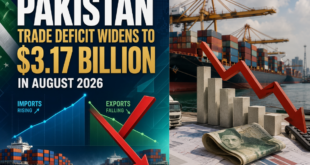
Pakistan’s trade deficit narrowed in August 2025 compared with July, though year-on-year data showed a sharp widening as exports declined and imports increased.
The Pakistan Bureau of Statistics–PBS–reported that exports fell to Rs 683.5 billion ($2.42 billion) in August from Rs 762.6 billion ($2.69 billion) in July, representing a decline of 10.4% in rupee terms and 10% in dollar terms. Imports also dropped during the month, falling to Rs1.49 trillion ($5.29 billion) from Rs1.66 trillion ($5.83 billion) in July, a contraction of 9.9% and 9.4% respectively.
This monthly decrease in both exports and imports resulted in an improved trade balance. The deficit narrowed to Rs810.5 billion ($2.87 billion) in August, compared with Rs896.4 billion ($3.15 billion) a month earlier, marking an improvement of 9.6% in rupee terms and 8.8% in dollar terms. Economists observed that the lower trade figures reflected subdued activity in both domestic and international markets, influenced by currency pressures and weaker global demand.
On a year-on-year basis, the picture was less favorable. Exports in August 2025 were down 11.2% in rupee terms and 12.5% in dollar terms compared with Rs769.4 billion ($2.76 billion) recorded in August 2024. Imports, meanwhile, rose 7.9% in rupee terms and 6.4% in dollar terms, climbing from Rs1.39 trillion ($4.97 billion) a year earlier. This divergence pushed the annual trade deficit higher by more than 30%, widening from Rs615.9 billion ($2.20 billion) in August 2024 to Rs810.5 billion ($2.87 billion) in August 2025.
Cumulative data for July–August 2025 also pointed to widening imbalances. Exports during the first two months of the fiscal year rose slightly by 2.4% in rupee terms and 0.7% in dollar terms, reaching Rs1.45 trillion ($5.10 billion) compared with Rs1.41 trillion ($5.07 billion) in the same period last year. Imports, however, surged by 16.2% in rupee terms and 14.2% in dollar terms, totaling Rs3.15 trillion ($11.12 billion) against Rs2.71 trillion ($9.73 billion) a year earlier. Consequently, the cumulative trade deficit jumped 31% in rupee terms and 29% in dollar terms, widening to Rs1.71 trillion ($6.01 billion).
The PBS noted that it had shifted its data source from the Pakistan Revenue Automation Limited (PRAL) to the Pakistan Single Window (PSW) system, which may result in rounding variations in reported totals.
Pakistan has historically faced recurring trade imbalances due to its heavy reliance on imported energy, raw materials, and consumer goods, while its exports remain concentrated in textiles and a narrow range of products. The August 2025 data underscored these challenges, with import growth outpacing modest export performance.
Economists and policy experts have consistently urged the government to prioritize export diversification, value-added industries, and regional trade expansion to mitigate long-term structural deficits. The State Bank of Pakistan has also cautioned that rising imports, if not offset by stronger exports or remittances, could place further strain on foreign exchange reserves and the rupee.
The government has indicated that reforms, including tariff rationalization and infrastructure development, will be key to boosting export competitiveness. However, with global commodity markets volatile and domestic industries under pressure, Pakistan’s trade outlook remains uncertain.
Despite the monthly improvement in August, the widening gap compared to last year highlights the persistent challenge of balancing imports with sustainable export growth in Pakistan’s economy.