 BeNewz
Related Articles




BeNewz Report
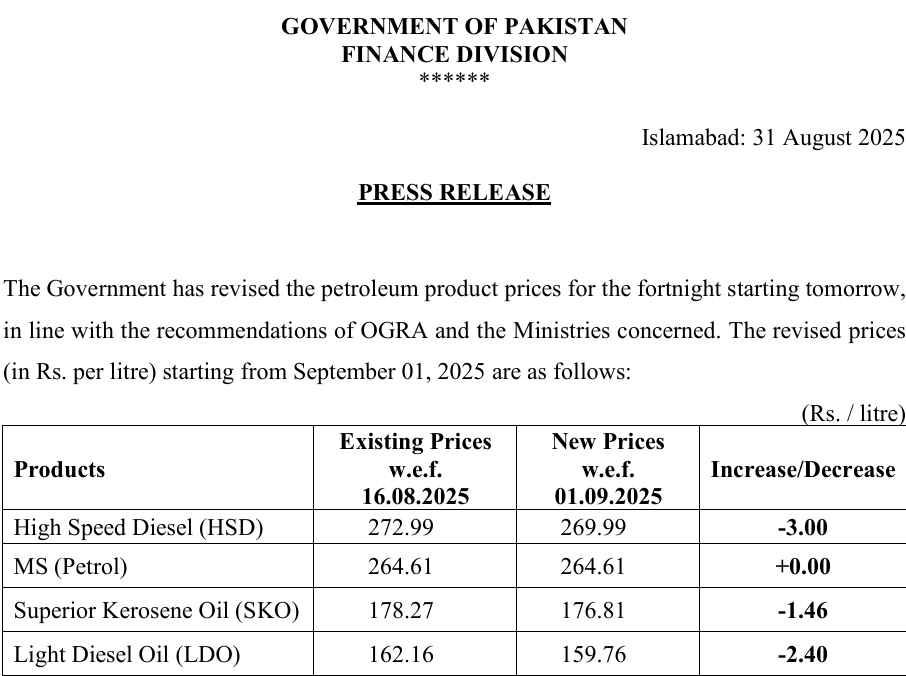
The Ministry of Finance has kept petrol prices unchanged while announcing a reduction in diesel and other petroleum product prices effective September 1.
The Ministry of Finance issued a notification stating that the current petrol price of Rs264.61 per litre will remain unchanged. However, the price of high-speed diesel has been reduced by Rs 3 per litre, setting the new rate at Rs 269.99 per litre.
Similarly, the price of kerosene oil has been reduced by Rs 1.46 per litre to Rs 176.81, while light diesel oil has been cut by Rs 2.40 per litre to Rs 159.76. According to the ministry, these revised prices took effect on September 1.
In Pakistan, petroleum product prices are revised every 15 days on the recommendation of the Oil and Gas Regulatory Authority (OGRA). International crude oil prices and the rupee’s value against the US dollar play a decisive role in these adjustments. The government’s decision to maintain petrol prices comes at a time when inflationary pressures and rising electricity and gas costs have already added to the public’s financial burden.
Economists note that the reduction in diesel prices could provide some relief to the transport and agriculture sectors, as diesel is directly linked to transportation costs and the running of agricultural machinery. However, the unchanged petrol price means that urban commuters and private consumers may not feel immediate relief.
Historically, decisions on fuel prices in Pakistan have often been influenced by both economic and political considerations. In 2022 and 2023, despite a decline in global oil prices, domestic consumers did not receive substantial relief, leading to criticism from the public and opposition parties.
According to the Ministry of Finance, the new prices aim to pass on global market fluctuations to consumers in Pakistan. Economic experts, however, argue that instead of short-term adjustments, the government should focus on diversifying energy sources and stabilising the rupee to ensure sustainable relief.
With the latest price revision effective from September 1, the government once again seeks to balance between easing public pressure and navigating the twin challenges of energy shortages and high inflation. The limited scope of the relief, however, means everyday expenses for ordinary citizens are unlikely to change significantly.