 BeNewz
Related Articles



Aftab Maken
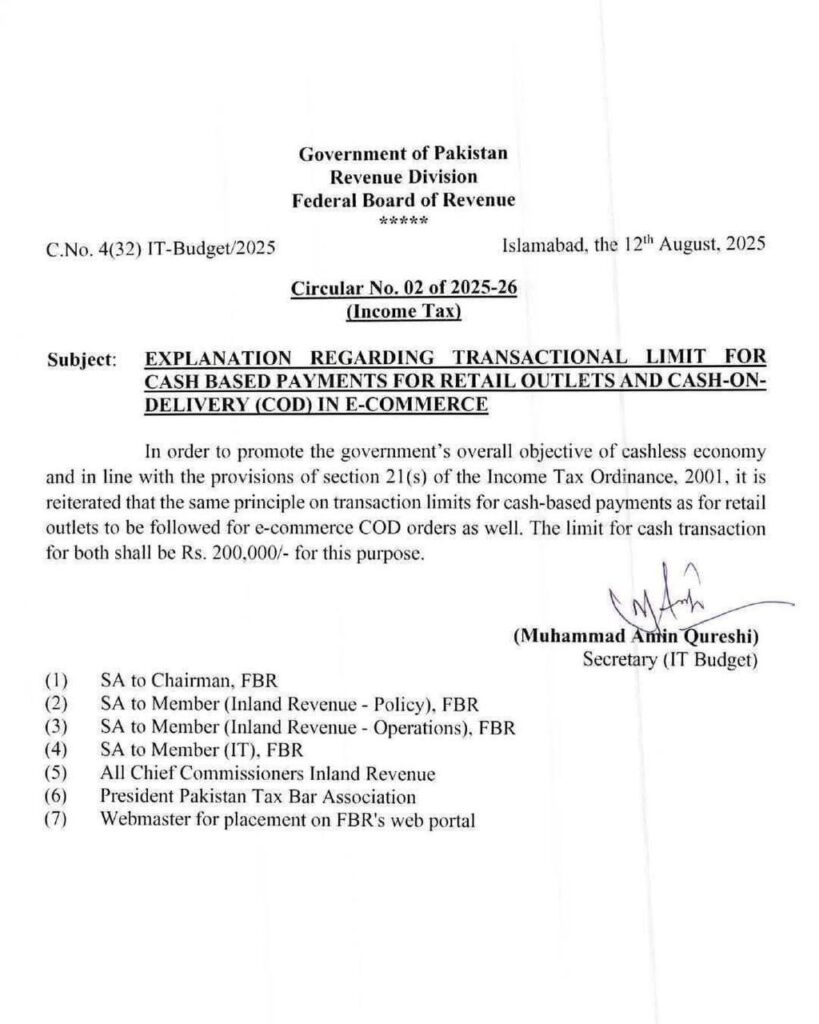
ISLAMABAD: To promote the digital economy and broaden the tax base, the federal government has imposed a cash transaction limit of Rs 200,000 for retail outlets and e-commerce Cash on Delivery (COD) payments.
According to a circular issued by the Federal Board of Revenue (FBR) on August 12, 2025, the measure aims to curb tax evasion and bring more economic activities into the documented sector. Copies of the circular have also been sent to the FBR Chairman and other relevant officials.
The circular, titled “Explanation Regarding Transactional Limit for Cash-Based Payments for Retail Outlets and Cash-on-Delivery (COD) in E-commerce,” seeks to advance the government’s broader vision of a cashless economy. Under this new regulation, no individual or entity will be allowed to make cash payments exceeding Rs 200,000 for any retail purchase or online order.
Officials noted that the decision is rooted in Section 21(s) of the Income Tax Ordinance, 2001, which disallows undocumented expenses often used for tax evasion. The move is expected to foster greater transparency in business transactions and encourage consumers to adopt digital payment methods. Experts believe this will strengthen the country’s digital payment infrastructure and boost the use of mobile wallets, bank transfers, and debit/credit cards.
The development poses both challenges and opportunities for Pakistan’s rapidly growing e-commerce sector, where a large majority of customers prefer COD. The Rs 200,000 limit will directly affect high-value online purchases such as electronics, furniture, and luxury items. E-commerce platforms are likely to introduce new incentives to promote digital payments while further upgrading their secure and user-friendly online payment systems.
The traditional retail sector will also feel the impact, particularly in large urban centers where high-value cash transactions are common for electronics, jewelry, and vehicles. Businesses will now be required to accept payments exceeding Rs 200,000 only through digital means, compelling them to train sales staff and expand alternative payment facilities.
Analysts believe this initiative could significantly boost tax revenues by reducing undocumented financial flows. It may also help in combating illegal transactions. However, the policy’s success depends heavily on public acceptance and the readiness of the business community to adapt.
Observers suggest that the government should launch a large-scale awareness campaign to educate people about the new regulation while simultaneously extending digital payment services to rural and remote areas. Effective monitoring and enforcement by the FBR will also be crucial for the success of the policy.