 BeNewz
Related Articles



Aftab Maken
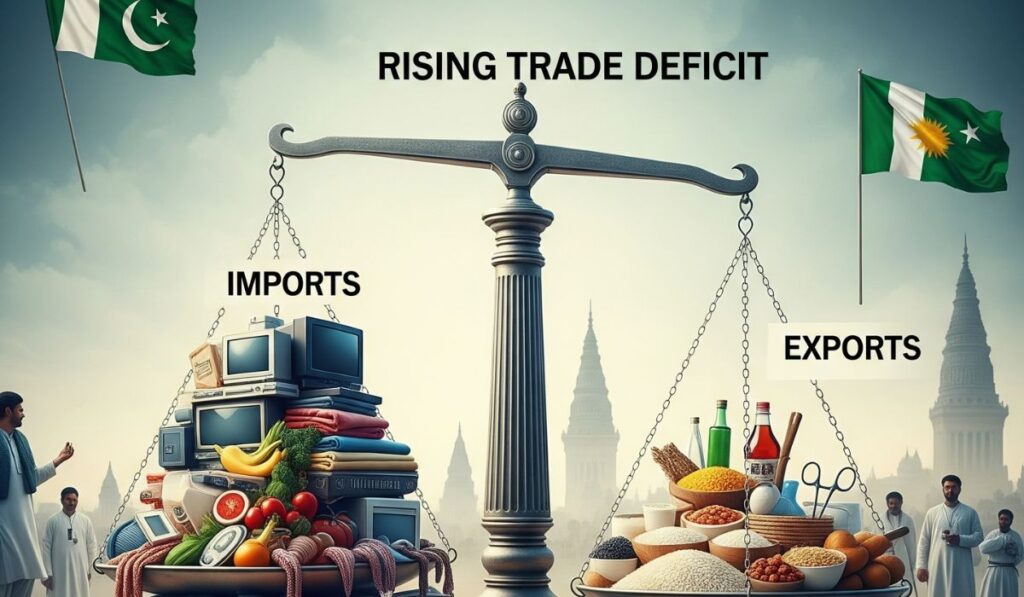
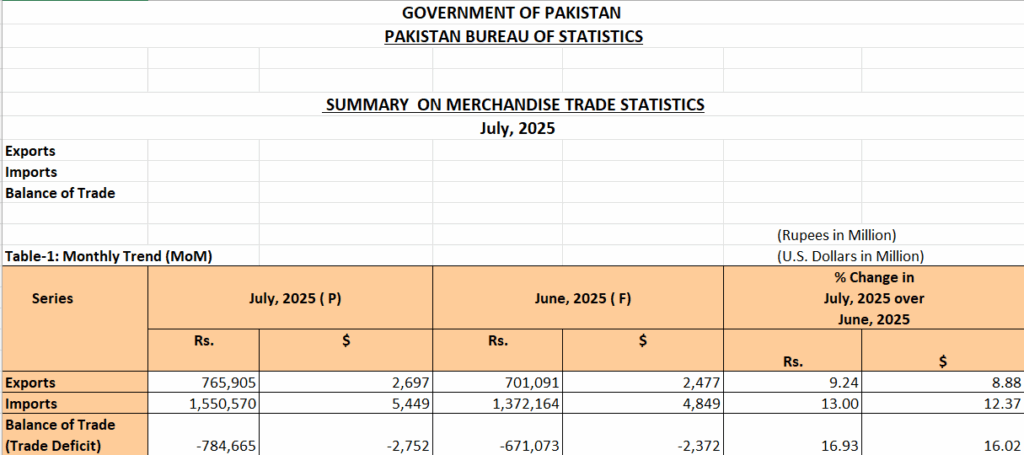
ISLAMABAD: Pakistan has encountered a significant economic challenge at the start of the new fiscal year, with its trade deficit recording a worrying increase in July 2025. According to the latest figures released by the Pakistan Bureau of Statistics (PBS), the trade deficit for the first month of the fiscal year 2025-26 surged to $2.752 billion, marking a substantial 44.16% increase on a year-on-year basis. These statistics reflect the pressure on the country’s economic health and external accounts.
The sharp rise in the trade deficit, which is the gap between exports and imports, has emerged as a major challenge for the economy. The data indicates that a significant increase in imports compared to the same month last year is the primary reason for this deficit. According to the monthly trade statistics report, exports in July 2025 totaled $2.697 billion, showing a 16.91% increase year-on-year. On a month-on-month basis, exports also saw an increase of 8.88%. While this growth is encouraging, it was overshadowed by the much larger increase in imports.
On the other hand, imports placed a significant burden on the trade balance. Imports in July 2025 increased by 29.25% year-on-year and 12.37% month-on-month, with their value reaching $5.449 billion. This extraordinary growth in the value of imports clearly shows the need for more effective policies to curb non-essential imports.
The data further reveals that the trade deficit not only grew on a year-on-year basis but also on a month-on-month basis, increasing by 16.02% in July. This continuously widening deficit is putting pressure on the economy and could negatively impact the country’s foreign exchange reserves.
This development comes at a time when Pakistan was celebrating recent positive economic news. In the last fiscal year, 2024-25, the country’s current account registered a surplus of $2.1 billion, which was a major success compared to the $2.1 billion deficit recorded during the fiscal year 2023-24. Prime Minister Shehbaz Sharif had expressed gratitude for this success, attributing it to the positive outcomes of government policies. This achievement had raised hopes that the country was on the path to economic stability, but the figures from the first month of the new fiscal year have presented a new challenge to that optimism.
The recent statistics serve as a warning to the government and policymakers that they need to re-evaluate their economic strategies. Immediate and effective measures are required to promote exports and control imports. If this trend in the trade deficit continues, it could become a significant obstacle to the country’s economic progress. Experts suggest that it is essential to find long-term and sustainable solutions to manage the trade deficit to put the country’s economy on a path of sustainable growth.