 BeNewz
Related Articles



Aftab Maken
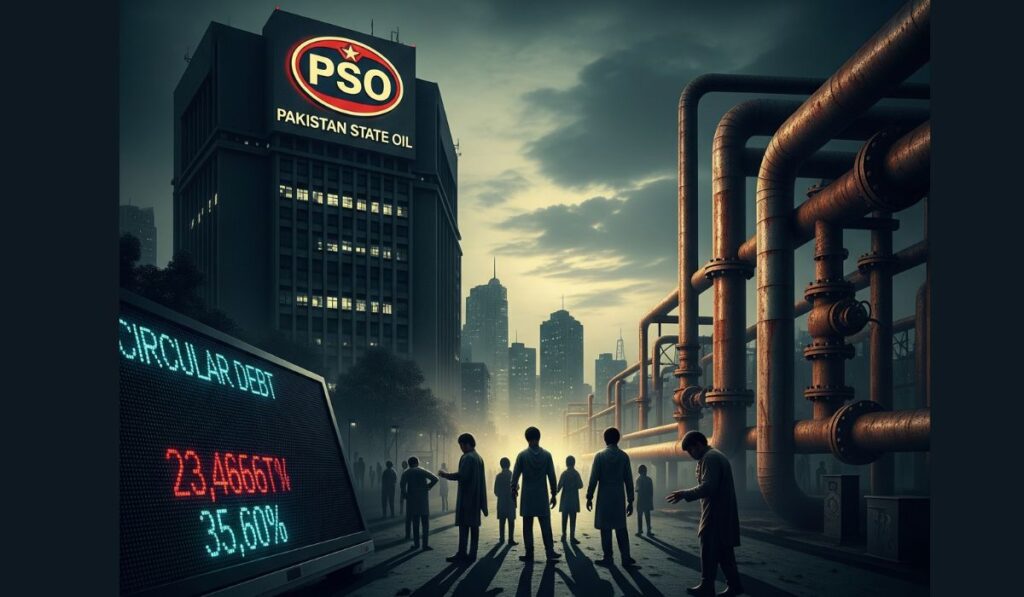
ISLAMABAD: While Pakistan State Oil (PSO) has announced a seemingly robust profit after tax of Rs 11.2 billion for the first half of FY25, up from Rs 7.7 billion in the same period last year, a closer look at the company’s financial health reveals a persistent and alarming vulnerability: the escalating circular debt. This formidable challenge casts a long shadow over PSO’s reported successes, threatening its liquidity and long-term stability.
Despite achieving gross sales of Rs 1.74 trillion, primarily driven by strong earnings in white oil, diesel, and Mogas, PSO remains deeply entrenched in a circular debt crisis, with receivables soaring to a staggering Rs 467 billion. The vast majority of this outstanding amount, a colossal Rs 340 billion, is owed by Sui Northern Gas Pipelines Limited (SNGPL). This astronomical figure highlights a critical systemic issue within Pakistan’s energy sector, where non-payment by one entity cascades through the supply chain, leaving key players like PSO grappling with severe cash flow constraints, said an official report of the Finance Ministry.
The magnitude of this debt cannot be overstated. While a profit increase of Rs 3.5 billion is certainly positive on paper, it pales in comparison to the nearly half-trillion rupees tied up in unpaid dues. This massive receivable effectively represents frozen capital that could otherwise be utilized for essential operations, further infrastructure development, or even to pay down PSO’s own obligations to local refineries and international suppliers. The continuous struggle to recover these funds forces PSO to seek external financing, incurring significant finance costs that eat into its profitability and ultimately burden the national exchequer.
Furthermore, the report acknowledges that the global and local economic outlook, while steady, remains “subdued.” The International Monetary Fund’s (IMF) projection of Pakistan’s GDP growth at 3 percent in FY25 and 4 percent in 2026, while indicating a gradual improvement, suggests that the broader economic environment will not provide a quick fix for PSO’s deeply rooted financial issues. The easing of inflation, attributed to fiscal consolidation and monetary tightening, might offer some respite on the expenditure front, but it does little to address the core problem of recovering long-standing debts from major clients.
Another concerning aspect of the petroleum sector’s dynamics is the sharp plummet in black oil sales, primarily due to reduced furnace oil demand. While PSO has managed to capitalize on the auto sector recovery and supply chain stabilization in other segments, the significant decline in black oil sales signifies a shift in energy consumption patterns that could pose a long-term challenge if not strategically addressed. Dependence on specific product segments, even those currently performing well, can be risky if demand patterns continue to evolve.
While PSO’s strategic infrastructure upgrades, retail network expansion, and digitization efforts are commendable for future growth, the pervasive issue of circular debt fundamentally undermines the benefits of these initiatives. Investing in expansion and modernization becomes significantly riskier when a substantial portion of the company’s working capital is unrecoverable. The “commitment to ensuring fuel supply reliability” is directly jeopardized by the financial strain imposed by these outstanding dues, potentially impacting PSO’s ability to maintain adequate inventory levels or invest in necessary upgrades for its supply chain.
In essence, despite presenting a positive profit figure, the report implicitly paints a picture of a company operating under immense financial pressure. The circular debt crisis, particularly the colossal sum owed by SNGPL, remains the single most significant threat to PSO’s financial resilience and its ability to contribute effectively to Pakistan’s energy security. Without a decisive and lasting resolution to this systemic issue, PSO’s reported profits will continue to be overshadowed by the specter of uncollected revenues, a burden that ultimately falls on the shoulders of the Pakistani taxpayer.