 BeNewz
Related Articles


Aftab Maken
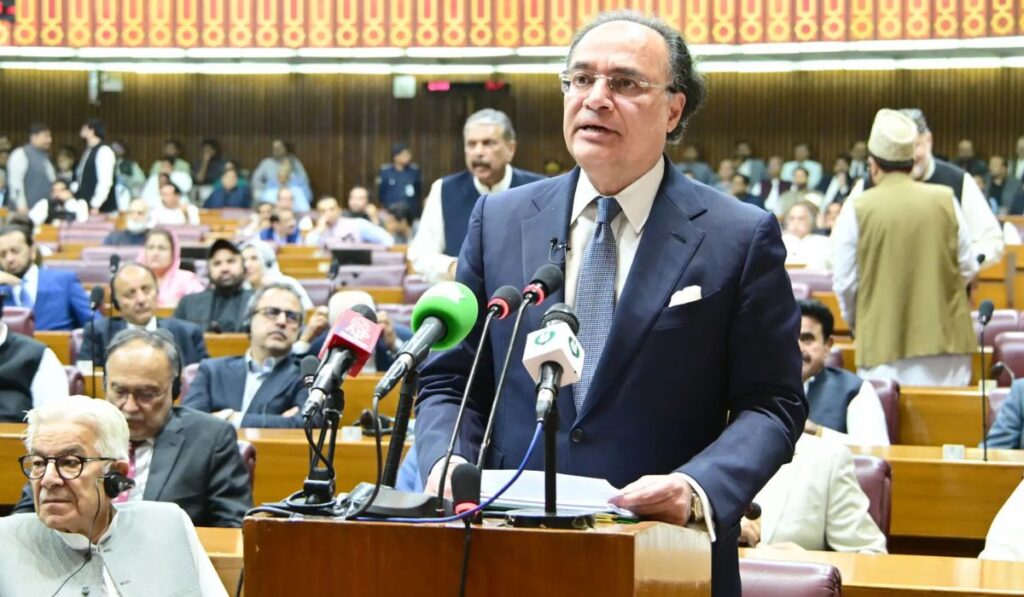
ISLAMABAD: Finance Minister Muhammad Aurangzeb on Thursday presented Pakistan’s Rs18.8 trillion federal budget for fiscal year 2026-27 in the National Assembly, outlining the government’s economic priorities, tax reforms, development plans, and defence spending amid noisy protests from opposition lawmakers.
The budget session began nearly two hours behind schedule as opposition members disrupted proceedings with slogans and demonstrations. Despite the unrest, the finance minister delivered a comprehensive speech highlighting the government’s economic achievements and future targets.
Aurangzeb announced that the government expects the economy to grow by 4 percent in FY2026-27, while average inflation is projected at 8.2 percent. The fiscal deficit is estimated at 3.6 percent of GDP, with a primary surplus target of 2 percent.
The government has projected tax revenues of Rs15.264 trillion for the coming fiscal year, representing a 17.6 percent increase over the outgoing year’s collection of Rs12.983 trillion. Federal non-tax revenues are expected to reach Rs5.336 trillion, while net federal revenues have been budgeted at Rs11.751 trillion.
The minister said Rs8.045 trillion would be allocated for debt servicing, making it the largest expenditure item in the budget. Defence spending has been set at Rs3 trillion, which Aurangzeb described as a top national priority, while civil administration expenditures have been budgeted at Rs1.071 trillion.
A key feature of the budget is a new federal-provincial financial arrangement under which provinces will contribute Rs8.848 trillion to help meet national strategic requirements while retaining their constitutional share under the 7th National Finance Commission Award. The mechanism will initially apply to FY2026-27 and may be extended in consultation with provinces.
For development spending, the federal government has allocated Rs1 trillion for the Public Sector Development Programme (PSDP). Including investments through state-owned enterprises and public-private partnerships, total development spending will rise to Rs1.451 trillion. Provinces have earmarked Rs2.224 trillion for their own development projects.
The government also announced several relief measures for salaried individuals and businesses. Income tax rates have been reduced across four income slabs, while the surcharge on salaried employees is proposed to be abolished. The super tax will be eliminated for businesses earning between Rs150 million and Rs500 million annually and reduced for larger corporations.
The budget also proposes the removal of taxes on sanitary pads and contraceptives. Government employees will receive a 7 percent salary increase, while pensioners will benefit from a 7 percent rise in pensions. The minimum wage is proposed to increase by 10 percent.
Aurangzeb highlighted the government’s social welfare commitments, announcing Rs280 billion for the Benazir Income Support Programme (BISP), Azad Jammu and Kashmir, Gilgit-Baltistan, and the merged districts of Khyber Pakhtunkhwa. Additionally, Rs1.169 trillion has been allocated for pensions and Rs1.091 trillion for subsidies in the power sector and other essential areas.
During his speech, the finance minister credited Pakistan’s economic recovery to reforms undertaken over the past two years. He stated that GDP growth in the outgoing fiscal year reached 3.7 percent, while large-scale manufacturing expanded by 6.1 percent and the services sector grew by 4.1 percent.
He noted that the size of Pakistan’s economy had increased to $452 billion, while per capita income rose to $1,901. Foreign exchange reserves climbed to $17 billion from just $4 billion three years ago, providing three months of import cover.
Remittances are expected to exceed $41 billion by the end of FY2025-26, marking the highest level in the country’s history, he added. The tax-to-GDP ratio has risen to 10.3 percent, while the fiscal deficit has narrowed significantly compared to 2023.
The finance minister also linked Pakistan’s improving international standing to its defence capabilities, particularly following the country’s response to India during tensions in May 2025. He said Pakistan’s defence sector had become a source of foreign exchange earnings and had strengthened strategic partnerships, including defence cooperation with Saudi Arabia.
Aurangzeb further highlighted Pakistan’s diplomatic efforts to promote peace between the United States and Iran and support the restoration of oil transit through the Strait of Hormuz. He reaffirmed Pakistan’s close ties with China, describing Beijing as the country’s most important trading partner.
Meanwhile, members of the Pakistan Peoples Party (PPP), a key coalition partner of the ruling government, staged a protest in the National Assembly over what they described as Sindh’s unfair share of water resources. PPP lawmakers carried placards highlighting a 48 percent water shortage in the province and chanted slogans demanding greater water allocations.
PPP Chairperson Bilawal Bhutto Zardari, whose attendance had remained uncertain until shortly before the session, eventually joined parliamentary proceedings after consultations with senior government officials. While reiterating the party’s support for the budget process in the national interest, PPP leaders called on the federal government to respect the party’s political mandate and address its concerns regarding provincial rights and resource distribution.
The budget now moves to parliamentary debate, where lawmakers will examine its fiscal measures and development priorities before final approval.