 BeNewz
Related Articles

BeNewz Report
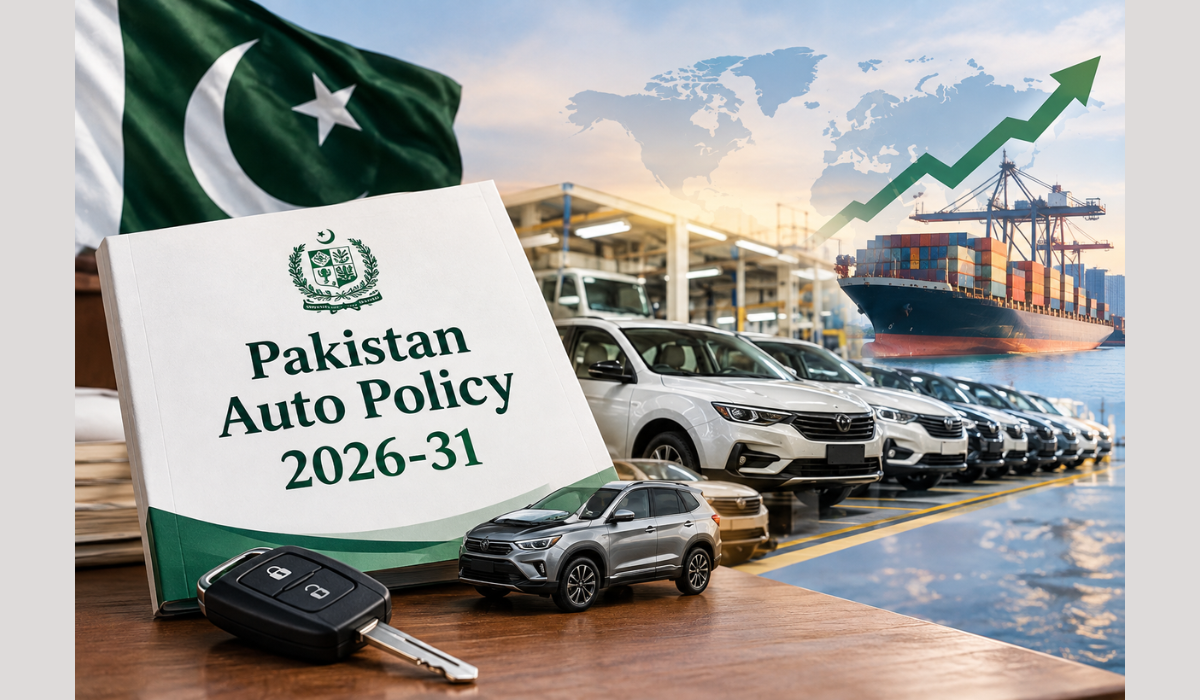
ISLAMABAD: The Pakistan Auto Policy 2026-31 drafted by the inter-ministerial committee headed by Federal Minister for Power Sardar Awais Ahmad Khan Leghari has proposed a sweeping restructuring of the country’s automobile sector, tying manufacturing licences to mandatory export quotas, phased tariff cuts of up to 80 percent, and a new domestic value-addition regime, according to official documents.
The plan aims to shift the industry away from decades of tariff protection towards performance-linked incentives, projecting combined OEM and parts-sector exports of $4.586 billion and foreign exchange savings of $17.70 billion over the five-year period.
Background: A Policy Born Out of Protection Fatigue
For decades, Pakistan’s auto sector grew behind high tariff walls, producing some of the region’s costliest vehicles while exporting almost nothing. The Pakistan Auto Policy 2026-31 attempts to break that pattern by making export performance, not import protection, the basis for staying in business — OEMs would have to lift exports from zero in 2026-27 to 12 percent of factory-gate value by 2030-31, with penalties including extra customs duty on CKD kits and eventual licence cancellation for repeat non-compliance. The policy also folds in a Minimum Domestic Value Addition regime, a Drawback of Local Taxes and Levies export subsidy funded by new duties on conventional vehicles, and a parallel New Energy Vehicles framework offering 1 percent sales tax and financing relief for EVs, PHEVs and REEVs.
Public and Industry Reaction
Reaction from within the sector has been sharply divided even before the policy’s finalisation. The Pakistan Association of Automotive Parts and Accessories Manufacturers has repeatedly asked the Prime Minister for direct talks, arguing that the parts industry — which it says underpins well over a million livelihoods — operates at a significant cost disadvantage against regional rivals and could lose ground if tariff cuts under the National Tariff Policy are applied without matching structural support for the sector, which the association says supports over 1.8 million livelihoods and contributes nearly 3 percent to GDP. Its leadership has warned that untethering tariff reductions from parallel reforms risks reversing years of localisation gains and could pressure Pakistan’s foreign exchange reserves rather than easing them by undermining local manufacturers’ competitiveness and triggering an import surge that strains reserves, contrary to the tariff policy’s own stated goals.
Assemblers have voiced similar alarm. The Pakistan Automotive Manufacturers Association has told the government that plants are already running at under half of installed capacity, and has sought direct intervention to avert what it frames as a deindustrialisation risk tied to cuts in completely-built-up import duties with assemblers and vendors describing an existential threat and citing utilisation below 50 percent of the industry’s 500,000-unit annual capacity, caused by repeated policy shifts and weak demand. Separately, PAAPAM has complained that an earlier draft of the policy was routed to the IMF for review without adequate consultation with the Engineering Development Board or industry bodies, a process it says undermined trust in the drafting exercise given the sector’s role supplying not just automakers but agriculture, motorcycles, commercial vehicles, appliances and defence engineering, while also earning foreign exchange through exports.
Expert Analysis: A Sound Framework With Execution Risk
Evaluated on its own numbers, the Pakistan Auto Policy 2026-31 is a coherent attempt to solve a real problem: Pakistan’s auto sector has never had to compete or export, and tariff protection alone was never going to change that. Tying manufacturing licences to enforceable export targets, and funding a DLTL rebate through FED on conventional vehicles rather than fresh budget outlays, is a fiscally disciplined design on paper — the committee’s own estimates show the scheme roughly breaking even, with Rs349.94 billion in additional FED collection against Rs328.83 billion in combined DLTL and PHEV tax-relief costs.
But three weaknesses stand out. First, the export ramp is steep and back-loaded — asking OEMs to go from zero exports to 12 percent of factory-gate value within four years is a demanding leap for firms that have never built for external markets, and the “additionality” requirement (that parts sourced to meet export quotas must be incremental to a supplier’s existing exports) could be difficult to audit in practice. Second, the fiscal arithmetic flips over the policy horizon: the committee’s own projections show the scheme moving from a Rs46.84 billion surplus in 2026-27 to a Rs44.10 billion deficit by 2030-31, meaning the subsidy design becomes progressively harder to sustain just as export obligations peak. Third, the price-stability claims deserve scrutiny — the report’s own comparisons show NEVs still pricier than their conventional counterparts in most segments (a Honri NEV above the Alto, a Haval PHEV above the Civic), suggesting consumer uptake of the new-energy push may lag unless financing incentives do more of the work than currently modelled. The core tension the industry associations are flagging — rapid tariff liberalisation without proportionate cost-of-doing-business reform (energy tariffs, financing costs, logistics) — remains the policy’s biggest unresolved risk, and one the report’s fiscal tables do not fully address.
Policy at a Glance
| Metric | Detail |
|---|---|
| OEM export target | 0% (2026-27) → 12% of factory-gate value (2029-31) |
| Combined OEM + parts exports (2026-31) | $4.586 billion cumulative |
| Minimum Domestic Value Addition (cars) | Rising to 40% by 2030-31 |
| Minimum Domestic Value Addition (NEVs) | Rising to 15% by 2030-31 |
| Tariff cut target | Up to 80% reduction; RD and ACD eliminated |
| DLTL export support | 10% baseline + 5% growth bonus on net FOB value |
| Additional FED collection (2026-31) | ~Rs349.94 billion |
| Net fiscal position (2026-31) | Rs21.11 billion savings, but deficit by 2030-31 |
| Forex savings from localisation (2025-31) | $17.70 billion cumulative |