 BeNewz
Related Articles


BeNewz Report
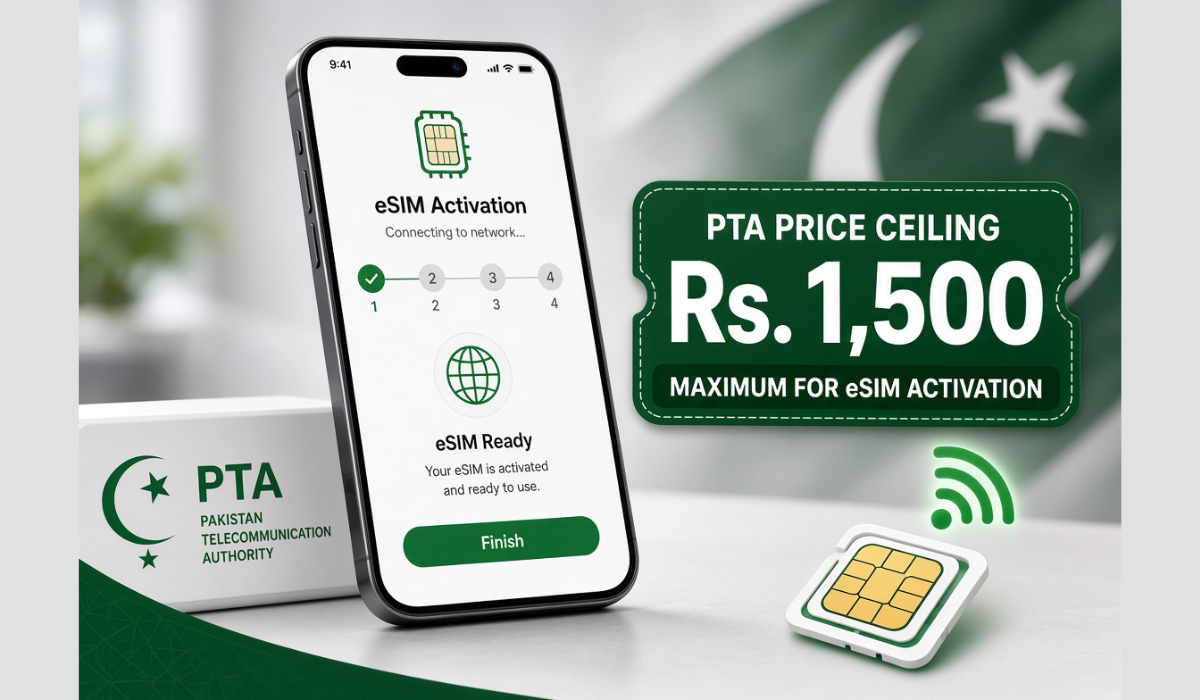
ISLAMABAD: The Pakistan Telecommunication Authority (PTA) has fixed a maximum retail charge of Rs. 1,500 for issuance of an eSIM or conversion from a physical SIM to an eSIM, inclusive of taxes and verification charges, in Pakistan, Azad Jammu & Kashmir and Gilgit-Baltistan.
The PTA eSIM price cap, notified through a formal determination dated 5th August 2026 and effective from 17th August 2026, comes despite the regulator’s own international benchmarking showing that major operators in India, the United Kingdom and Australia issue eSIMs completely free of cost, while Nepal charges roughly Rs. 90 to 190 and Bangladesh charges Rs. 800 to 910 for the same service.
Background: A Regulator Responding to Years of Complaints
According to the determination, PTA had received multiple complaints and reports that eSIM issuance charges in Pakistan were priced far higher than in comparable markets, prompting consumers and stakeholders to demand uniform, rationalized pricing to encourage wider eSIM adoption.
The scale of the problem is stark: as of June 2026, Pakistan had only 459,000 active eSIM subscribers, a strikingly low figure for a country of over 240 million people at a time when the government has repeatedly framed digital transformation as a national priority.
PTA initiated consultation with all Cellular Mobile Operators (CMOs) through letters dated 4th September 2025 and 2nd March 2026, followed by a hearing on 9th July 2026 attended by representatives of PTML, Jazz and CMPak, and a separate consultative meeting with SCO on 15th July 2026.
Operators Resisted Lower Prices, Records Show
The CMOs’ own submissions, reproduced in the determination, reveal a consistent pushback against meaningfully lowering eSIM prices. Jazz argued that its pricing reflects “unique local market and cost dynamics” rather than any intent to slow adoption. Telenor went further, warning that reducing eSIM prices was “unlikely to materially accelerate adoption” and could cause “structural margin erosion” and shift costs onto other subscribers.
CMPak maintained that its pricing was “market compatible” with global industry practice, while PTML noted that SIM and eSIM pricing had already been deregulated by the Authority and that it did not even require PTA approval to change prices. Notably, none of the four operators’ submissions engaged with the fact that peer markets such as India and the UK charge nothing at all for the same service.
Public and Consumer-Rights Reaction
Since the determination became public, consumer advocates and telecom watchers online have questioned why a regulator that explicitly documented free eSIM issuance in India, the UK and Australia would still permit operators to charge up to Rs. 1,500 in Pakistan.
Commentary circulating on social media has focused on the low uptake figure of 459,000 subscribers as evidence that high pricing, not technical limitations, has been the real barrier to eSIM adoption, with several users describing the new ceiling as a “cap on overcharging” rather than genuine price relief for consumers already burdened by high mobile taxation.
Analyst View: A Ceiling, Not a Cut
Telecom policy analysts note that PTA’s order does not reduce prices — it merely caps what operators can charge, at a level roughly eight to sixteen times higher than Bangladesh’s rate and, by the regulator’s own data, infinitely higher than the zero-cost model used in India, the UK and Australia.
Critics argue that by setting the ceiling at Rs. 1,500 rather than closer to regional benchmarks, PTA has effectively validated the operators’ existing pricing rather than correcting it, even though the Authority’s own determination states it has full mandate under the Pakistan Telecommunication (Re-organization) Act, 1996 to act in the interest of consumers.
The one-year review clause attached to the price cap has also drawn scrutiny, with observers noting that Pakistan’s eSIM charges could remain among the highest in the region for at least another year before any further reassessment.
What the Determination Actually Changes
On the positive side, the order does introduce one clear consumer protection: transfer of an eSIM profile from one device to another must now be free of charge up to ten migrations, standardizing a benefit that previously varied by operator — Jazz and Ufone already allowed ten free transfers, Zong allowed five, and Telenor allowed only three, while SCO charged for every transfer.
The order also bars licensees from adopting “unfair commercial practices” while implementing the decision, though it does not define specific penalties for violations.
Image Alt Text: PTA eSIM price cap determination document showing new maximum eSIM issuance charges in Pakistan