 BeNewz
Related Articles



Aftab Maken
ISLAMABAD: The Pakistan solar battery boom has moved from a niche trend to a defining feature of the country’s energy landscape, with homeowners and businesses installing rooftop panels and battery storage faster than almost any other market on Earth. What began as a response to chronic loadshedding has evolved into a nationwide shift toward energy self-sufficiency, driven as much by economics as by frustration with an unreliable grid.
Pakistan had installed over 50 GW of solar panels as of early 2026, and the country is now adding storage at a similarly rapid clip. Cumulative lithium-ion battery storage imports reached 7.6 gigawatt-hours by the end of 2025, marking a 220 percent year-on-year increase, and Pakistanis are now installing batteries at a rate exceeding 5 GWh annually.
Background: From Rooftop Panels to Whole-Home Storage
The Pakistan solar battery boom did not happen overnight. By fiscal year 2025, 7.3 million households in Pakistan had solar installed on their rooftops — out of roughly 40 million households nationwide, meaning nearly one in five Pakistani homes now generates its own power. Battery adoption is following the same trajectory but at an even faster pace: around 282,000 solarized households, roughly 4 percent of them, now also have battery energy storage systems installed.
Falling equipment costs have been central to this shift. Battery prices have dropped about 75 percent over the past decade, from over $460 per kilowatt-hour in 2015 to approximately $110 per kilowatt-hour in 2024, with further declines expected as cheaper sodium-ion technology enters the market. Provincial growth has been uneven but broad: Punjab’s rooftop solar installations quadrupled in 2026, while Khyber Pakhtunkhwa and Balochistan together hold roughly 15 percent of the market, constrained by lower per-capita incomes.
The Pakistan solar battery boom has also reshaped the national economy’s exposure to imported fuel. The country has avoided more than $12 billion in oil and gas imports cumulatively up to February 2026, with a further $6.3 billion in potential savings still ahead. Analysts note that solar’s rise briefly softened the blow of a recent regional fuel-supply shock, as solar generation largely met daytime electricity demand even after the government was forced to reintroduce evening loadshedding during the crisis.
Regulatory change is now testing the boom’s momentum. NEPRA announced a shift from net metering to a net billing framework on February 9, 2026, under which residential consumers receive only Rs 11 per unit for excess electricity exported to the grid, compared to Rs 25 per unit previously — a change expected to lengthen payback periods for new rooftop systems even as battery uptake continues to climb.
Public Reaction: A Grid Bypassed, Household by Household
Online, the Pakistan solar battery boom is widely framed as a rare consumer success story amid economic strain. Homeowners routinely share photos of rooftop panel installations and battery setups, crediting them with cutting monthly electricity bills and providing backup during outages.
Solar installers and electronics retailers report steady inquiries from middle-income households looking to add batteries to existing panel systems, particularly after recent net-billing changes made grid exports less attractive than self-consumption.
Expert Analysis
Energy analysts describe the Pakistan solar battery boom as a rare case of a developing economy leapfrogging into distributed, resilient energy infrastructure without waiting for top-down policy design.
Muhammad Mustafa Amjad of Renewables First noted that Pakistan has already gone through a consumer-led rooftop solar transition, and battery storage is now following an even faster trajectory, making it essential for policymakers to build storage into energy planning early to ensure the shift benefits all income groups.
Ember researchers have flagged a new complication: as solar adoption has grown, it has reshaped the national load curve by pushing peak demand into the evening hours — a period solar cannot serve, meaning battery storage and grid planning will need to evolve together for the boom to translate into full grid stability rather than a new bottleneck.
At a Glance: Pakistan’s Solar and Battery Boom (2026)
| Indicator | Latest Figure |
|---|---|
| Installed rooftop/utility solar capacity | Over 50 GW (early 2026) |
| Cumulative battery storage imports (end-2025) | 7.6 GWh (+220% YoY) |
| Current annual battery installation rate | 5+ GWh/year |
| Households with rooftop solar (FY25) | 7.3 million (~1 in 5 homes) |
| Solarized households with battery storage | ~282,000 (~4%) |
| Battery price decline (2015–2024) | ~75% (from ~$460/kWh to ~$110/kWh) |
| Oil & gas import savings from solar (to Feb 2026) | $12 billion+ |
| Net billing export rate (from Feb 2026) | Rs 11/unit (down from Rs 25/unit) |
| Solar market value (2026) | $2 billion+ |
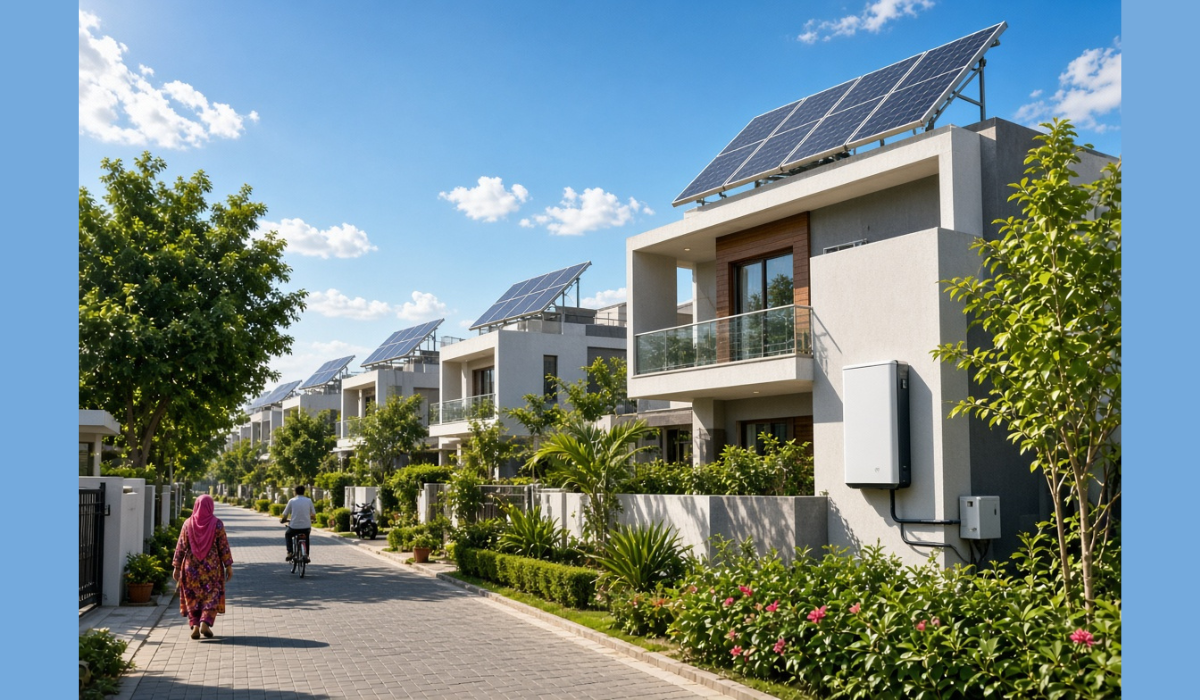
Rooftop solar panels and battery storage units installed on a residential home in Punjab, part of the ongoing Pakistan solar battery boom.