 BeNewz
Related Articles



Aftab Maken
ISLAMABAD: The Higher Education Commission has introduced a new nationwide policy making GRE/HAT General and relevant subject tests mandatory for admissions to MPhil, MS and PhD programs at public and private universities from Fall 2026.
According to a notification issued by the coordination division of the Higher Education Commission, admissions to Level 7 programs, including MS, MPhil or equivalent degrees, and Level 8 programs, including PhD or equivalent qualifications, will only be granted on the basis of GRE/HAT General and subject tests conducted under the Education Testing Council.
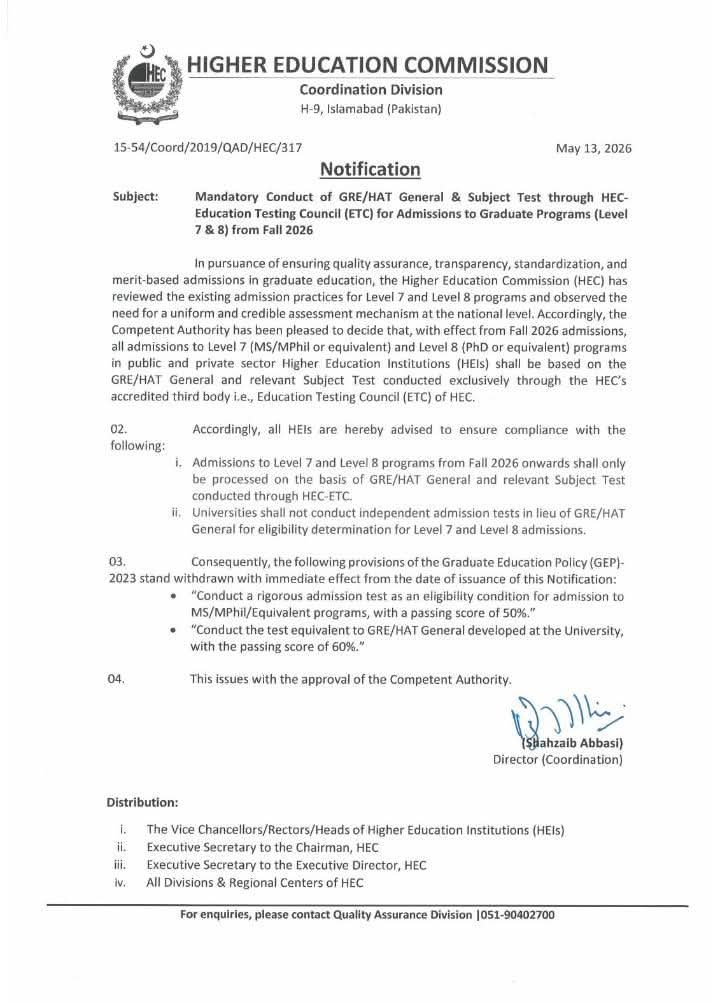
The notification stated that all universities and higher education institutions across Pakistan would be required to implement the decision. Only candidates who successfully pass the prescribed HEC ETC tests will be considered for admission from the Fall 2026 session onward.
HEC clarified that universities will no longer be allowed to conduct separate or internal admission tests for MPhil, MS and PhD programs. It added that university-developed tests would also not be considered equivalent alternatives to GRE or HAT examinations.
Under the new policy, several clauses of the Graduate Education Policy 2023 have been withdrawn with immediate effect. These include the provision allowing universities to conduct their own admission tests with a 50% passing score requirement.
The commission has also abolished the clause permitting universities to design GRE/HAT-equivalent tests with a 60% passing score. The revised framework centralizes graduate admissions testing under the HEC’s Education Testing Council.
HEC said the new system aims to ensure transparency, uniformity, merit and improved academic standards in graduate admissions nationwide. Officials believe a centralized testing mechanism will help create consistency in admission criteria across universities and strengthen confidence in the higher education system.
Education experts say the move could improve fairness and standardization in postgraduate admissions, particularly among institutions with varying testing procedures. However, some academic circles have raised concerns over reduced university autonomy and limitations on independently designed assessment systems.
Pakistan’s higher education sector has undergone multiple policy reforms in recent years aimed at improving research quality, international recognition and academic accountability. The latest decision is expected to significantly reshape graduate admissions procedures for universities preparing for the Fall 2026 intake.