 BeNewz
Related Articles


Aftab Maken
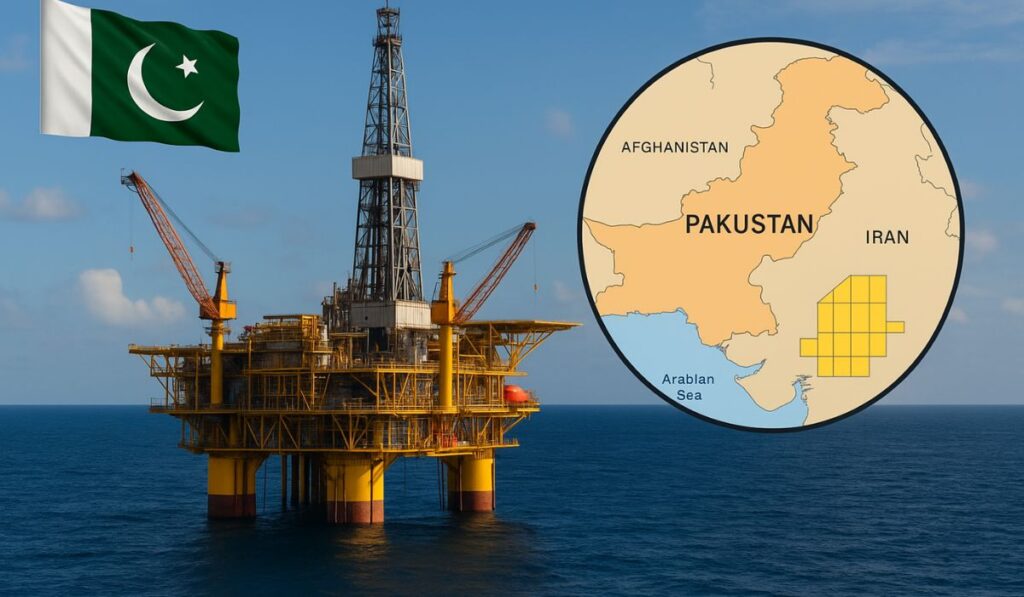
Pakistan has awarded 23 offshore oil exploration blocks in its first bidding round in 18 years, signaling renewed investor confidence and a major step toward enhancing domestic oil and gas output.
The Ministry of Energy confirmed that four consortiums — led by state-run Oil and Gas Development Company Ltd (OGDCL), Pakistan Petroleum Ltd (PPL), MariEnergies, and Turkey’s national oil firm Türkiye Petrolleri Anonim Ortaklığı (TPAO) — secured the offshore blocks covering around 53,500 square kilometers. The consortiums have pledged an initial investment of $80 million for exploration, which could reach up to $1 billion if commercial drilling proceeds.
Pakistan, which imports around 85% of its crude oil and nearly 30% of its natural gas, is under growing pressure to reduce its $17.5 billion energy import bill, projected to nearly double by 2030. According to the Petroleum Division, the awarded blocks are part of efforts to tap Pakistan’s estimated 235 trillion cubic feet (TCF) of offshore gas reserves and strengthen energy security.
The agreement follows a joint bidding pact signed in April between OGDCL, PPL, TPAO, and MariEnergies to explore Pakistan’s 300,000 square kilometre offshore zone bordering the UAE, Oman, and Iran. Despite significant potential, only 18 offshore wells have been drilled since independence, reflecting chronic underinvestment in the sector.
In June, Pakistan Oilfields Ltd and OGDCL announced a major offshore discovery at the Makori Deep-03 well, producing 2,112 barrels of condensate and 22.08 million standard cubic feet of gas per day. Experts, however, caution that unlocking Pakistan’s offshore hydrocarbon potential could require up to $5 billion in exploration costs and as much as $30 billion in total investment over the next decade to develop just 10% of the country’s gas reserves.
Security and political instability remain major hurdles. Persistent threats in resource-rich regions like Balochistan and Sindh have disrupted project development, while foreign investors remain wary of committing long-term funds amid concerns over safety and governance.
The government’s broader energy strategy continues to rely heavily on infrastructure development under the China-Pakistan Economic Corridor (CPEC), Beijing’s $62 billion initiative. CPEC projects have added thousands of megawatts to Pakistan’s grid through coal, hydropower, and renewable projects, and upgraded key transmission networks such as the 660 kV Matiari-Lahore HVDC line.
However, CPEC-related borrowing has contributed to Pakistan’s ballooning debt, now at around $269 billion, with $87.4 billion in external liabilities. Analysts say the country’s weak tax base — with a tax-to-GDP ratio of 15.7%, far below regional averages — has left Islamabad increasingly dependent on foreign loans to finance both energy and infrastructure projects.
Despite these challenges, the award of 23 offshore blocks marks a renewed push by Pakistan to attract foreign investment, reduce import dependence, and explore untapped offshore oil and gas reserves.