 BeNewz
Related Articles


BeNewz
ISLAMABAD: Pakistan’s energy storage sector stands at a turning point. Government projections show domestic lithium-ion battery demand climbing to 40-51GWh by 2031, putting the market’s potential value at $6.5bn-$9bn — a scale that would make batteries one of the country’s most consequential new industries if local manufacturing can be built in time.
The import problem
Right now, that opportunity is mostly going abroad. Government investment data pegs Pakistan’s import dependence for battery cells, packs and critical materials at over 80 percent, and without a serious domestic manufacturing push, the annual import bill could balloon to $2bn-$3.15bn as demand rises across electric vehicles, solar storage and backup power.
Pakistan imported an estimated 1.25GWh of lithium-ion battery packs in 2024, with demand projected to increase to around 8.7GWh by 2030 — a nearly sevenfold jump in six years that underscores how quickly the import bill could grow without local supply.
The policy response
In response, the government has spent the past year building the National Lithium-Ion Battery Manufacturing Policy 2026-31, aimed at phased localisation, tariff reform and performance-based incentives. A high-level meeting chaired by Special Assistant to the Prime Minister Haroon Akhtar Khan reviewed the policy’s progress, with the committee approving lithium iron phosphate (LFP) battery technology for initial localisation and stressing the need for testing, certification and recycling infrastructure. A dedicated working group for the policy was constituted in December 2025 on the prime minister’s instructions, and the plan is meant to fully integrate battery manufacturing into Pakistan’s national energy security framework, with public-private partnerships playing a central role.
By spring, the policy had moved further along. The Engineering Development Board forwarded the draft to the Ministry of Industries and Production, ahead of a National Tariff Board review of duty reductions on imported components used in battery assembly and manufacturing, with cabinet approval and inclusion in the Budget 2026-27 expected to follow.
First plants breaking ground
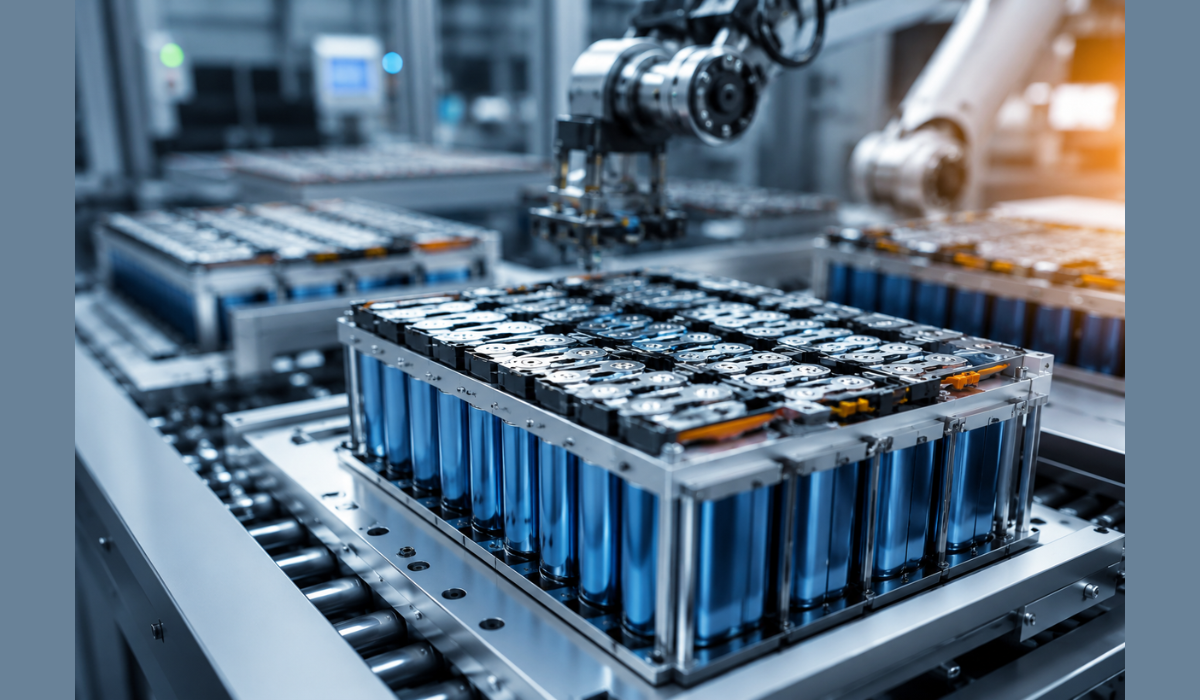
The clearest sign of momentum is in Karachi’s Korangi Industrial Area, where the country’s first dedicated lithium-ion facilities are taking shape. EV Technologies has ordered its production line and expects to begin operations within two to three months, with an initial capacity of 4 megawatts — enough to supply batteries for around 2,000 e-bikes and e-scooters a month, according to CEO Huma Khattak. The plant is set to be Pakistan’s first NMC (nickel manganese cobalt) battery-manufacturing operation, distinct from the LFP chemistry the government has prioritised for broader localisation.
Zilo Energy has since entered the same industrial zone, claiming to have installed what it describes as Pakistan’s most advanced lithium-ion assembly line at Korangi — though industry watchers note there’s still ambiguity over how much of this activity is true cell manufacturing versus pack assembly. On the vehicle side, global EV maker BYD has partnered with Mega Motor Company, a Hub Power Company subsidiary, to build a plant near Karachi with a projected annual capacity of 25,000 units, adding fresh pressure for battery suppliers to localise alongside it.
Pushback and social media reaction
Not everyone is on board with the pace or shape of the transition. Pakistan’s conventional auto industry has pushed back hard against the parallel Auto Policy 2026-31, which it says favours EVs without a clear transition path for existing manufacturers. The parts-makers’ association Paapam argued that Pakistan should move toward EVs but only gradually, with incentives tied to rising localisation and technology transfer to local vendors — pressure that reportedly reached the prime minister and led to the auto policy draft being shelved for revision. The lapse of the Auto Industry Development and Export Policy 2021-26 on June 30 also triggered an automatic 25 percent sales tax on many locally assembled and imported hybrids, hitting the sector just as the new framework stalled.
Commentary in the trade press has been split between cautious optimism and skepticism about follow-through. One analysis in The News called the battery policy a strategic signal rather than routine bureaucracy, since it treats energy storage as industrial infrastructure for the first time — while also warning that a lithium-only focus risks leaving Pakistan exposed to a single mineral supply chain. That piece argued Islamabad should build a parallel track for sodium-ion technology as a hedge, given Pakistan’s limited domestic lithium processing capacity. Industry social media discussion around the EV and battery rollout has largely tracked this same divide: enthusiasm over Korangi’s new plants and the BYD tie-up, set against frustration from parts manufacturers who feel sidelined by policies drafted without enough local-vendor consultation.
What still needs to be built
Assembly alone won’t create a globally competitive industry. Beyond the manufacturing line itself, Pakistan still lacks much of the surrounding infrastructure a real battery sector needs: strong battery-management-system electronics, national testing and certification facilities, and a structured recycling framework — though the New Energy Vehicle Policy already outlines collection, disassembly and recycling steps on paper.
Cost competitiveness is the other open question. Export-oriented manufacturers can lean on the Federal Board of Revenue’s Export Facilitation Scheme, which was extended in March from a nine-month to an 18-month input-utilisation window, easing some cost pressure. But with LFP dominating cost-sensitive segments globally and sodium-ion technology advancing quickly elsewhere, Pakistan’s policy will need enough flexibility to avoid locking manufacturers into one chemistry as the global battery landscape keeps shifting.
For now, the realistic path runs through the smaller entry points — pack assembly, casings, battery-management electronics — rather than full-scale cell manufacturing from day one. If Karachi’s early plants scale up and the policy clears its remaining approval stages on schedule, Pakistan could start converting a growing import bill into a domestic industrial base. If it stalls the way the parallel auto policy has, the $9bn opportunity risks staying exactly that — an opportunity, not an industry.