 BeNewz
Related Articles




Aftab Maken
ISLAMABAD: Quaid-i-Azam University (QAU) has formally opened admissions for the Fall 2026 semester, with its official website carrying a live banner directing applicants to the online admission portal. The university’s homepage currently displays “Admissions Open (Fall-2026) – Click here to Apply!” alongside a notice that the HEC USAT requirement has been waived for BS admissions.
According to separate notices issued by the university’s Admissions Section, the schedule for Fall 2026 has been set out program-wise. Undergraduate BS, LLB and morning Pharm.D applications on the Regular/Self-Finance basis must be submitted by 22 September 2026, while BS/LLB on a Self-Support basis and evening Pharm.D have a deadline of 29 September 2026. Applications for MPhil/MS programmes are due by 21 August 2026, and PhD applications close on the same date, 21 August 2026.
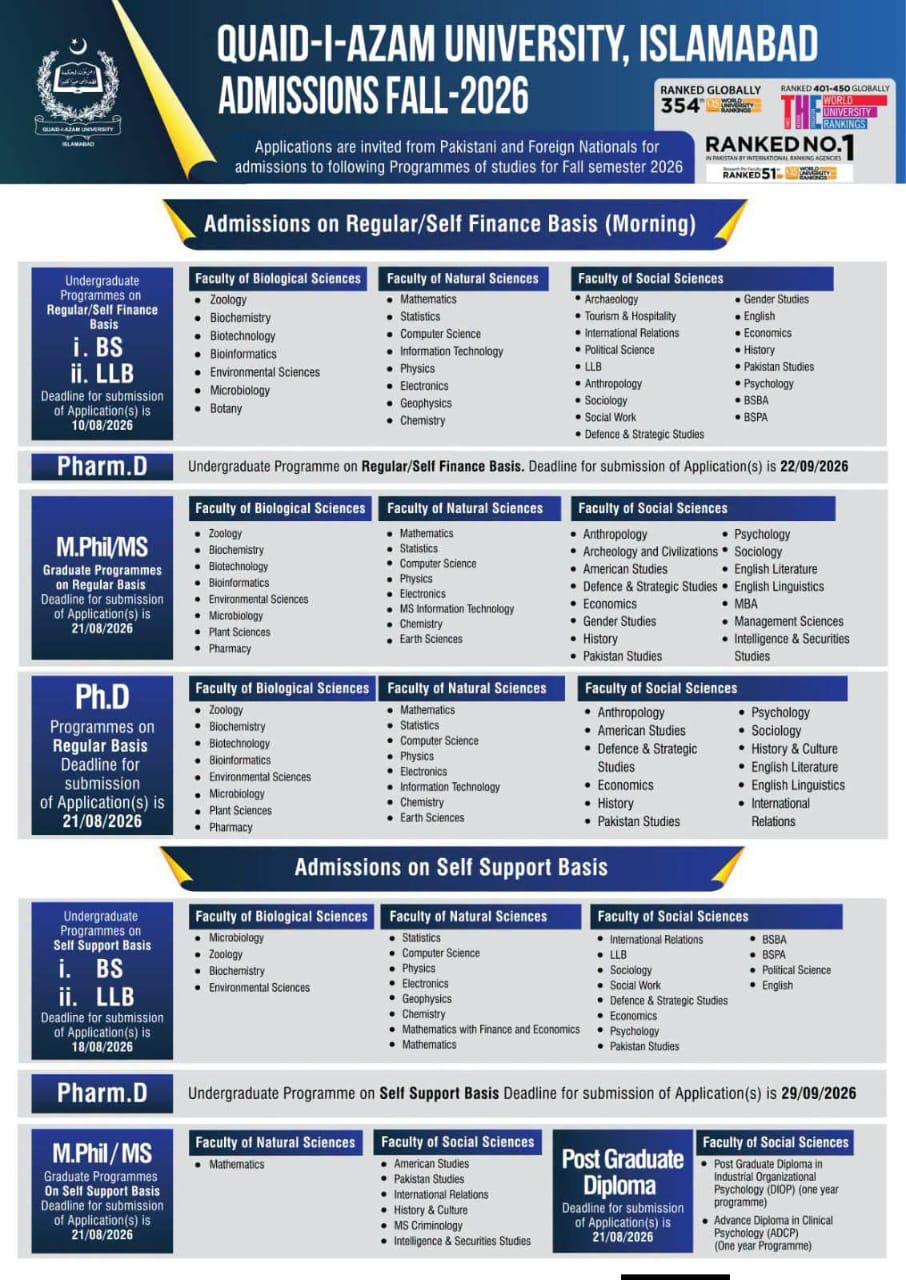
These dates mark a shift from the schedule that had circulated earlier in the year, when undergraduate deadlines were reported as 10 August 2026 for Regular/Self-Finance and 18 August 2026 for Self-Support admissions — suggesting the university revised and re-issued its admission timeline before finalising the schedule now live on its portal.
This time QAU administration is focussing more on social media Ads rather relying on conventional media campaign in top media newspaper. Insiders told this correspondent that QAU earlier Admission Ads campaigns run on main stream media was “Credit Note” and QAU has yet make payment of Rs 7 million to the Newspapers as it had not enough funds to run it again on main media newspaper rather focussing on “Social Media”.
Waived testing requirement, and a quiet concern over applicant numbers
Besides waiving the HEC USAT requirement for BS admissions — a move announced directly on the university’s homepage — QAU is understood to be grappling with a separate, less publicised concern: a lower-than-expected number of aspirant candidates for its BS programmes this cycle. According to faculty members at the university who spoke on condition of anonymity, citing the sensitivity of the matter, this is the reason the university has been repeatedly running admission-outreach campaigns on its social media pages, pushing students to apply before the deadlines close. QAU’s official admissions Facebook page, which has amassed around 27,550 followers, has been one of the primary channels used for this outreach, alongside similar activity flagged on the university’s Twitter/X account.
Neither claim — the applicant shortfall or its link to the social media push — has been confirmed on record by university officials, and QAU has not issued any public statement acknowledging a decline in BS applications.
Financial backdrop: HEC and ECC support continues
The renewed admission drive comes as QAU continues to lean on external financial support to stay afloat. The university has for years operated in close coordination with the Higher Education Commission (HEC), to which it is formally affiliated as a public national university, and has increasingly required intervention from the federal government’s Economic Coordination Committee (ECC).
In August 2025, the ECC, headed by Finance Minister Muhammad Aurangzeb, approved in principle a Rs 2 billion bailout grant for QAU, contingent on the university preparing a comprehensive financial self-sustainability plan. The approval came after QAU’s financial troubles deepened due to funding that had remained stagnant since 2018 despite rising inflation, with delayed salaries and an exhausted pension fund among the warning signs flagged at the time. The university’s Academic Staff Association welcomed the bailout, noting that the recurring HEC grant for salary expenses had stayed frozen at roughly Rs 65 billion since 2018.
The financial oversight has not let up since. As recently as last month, the ECC reviewed a Financial Sustainability and Governance Plan submitted by QAU but withheld approval, instead directing the university to engage independent financial experts to build a stronger, more realistic roadmap toward long-term sustainability.
Separately, HEC has continued to channel scholarship and research funding directly into the university. QAU’s Office of Scholarship and Financial Assistance, run in collaboration with HEC, currently lists disbursements including an HEC Need & Merit Based Scholarship worth over Rs 17.6 million and an HEC-linked Fellowship for MPhil and PhD students worth over Rs 44.4 million, alongside smaller grants from bodies such as the British Council and OGDCL.
Earlier reporting also placed QAU among a group of federal universities flagged for chronic underfunding: HEC and the Ministry of Federal Education and Professional Training sought a supplementary grant of Rs 2.5 billion to address funding shortfalls at QAU, the International Islamic University Islamabad, and the Federal Urdu University of Science and Technology.
For now, admissions for Fall 2026 remain open across QAU’s undergraduate, MPhil/MS and PhD programmes, even as the university’s underlying finances remain under close watch from both its regulator and the federal government’s top economic decision-making body — and, according to internal sources, as it works to shore up interest in its BS programmes through an active social media push.