 BeNewz
Related Articles



Dr Hassan Abbas
India’s construction of run-of-river projects and diversion tunnels on the Chenab River has reignited one of South Asia’s most dangerous disputes: water. For Pakistan, where the Chenab feeds the Lower Chenab Canal irrigating ∼2.8 million acres, supplies to link canals to feed Ravi and Sutlej which were forfeited to India under the Indus Waters Treaty (IWT), and supplying drinking water to millions; any reduction in lean-season flows is not just an engineering issue — it’s an existential one. As India moves ahead with works to transfer Chenab water to the Beas basin, Pakistan faces pressure to respond.
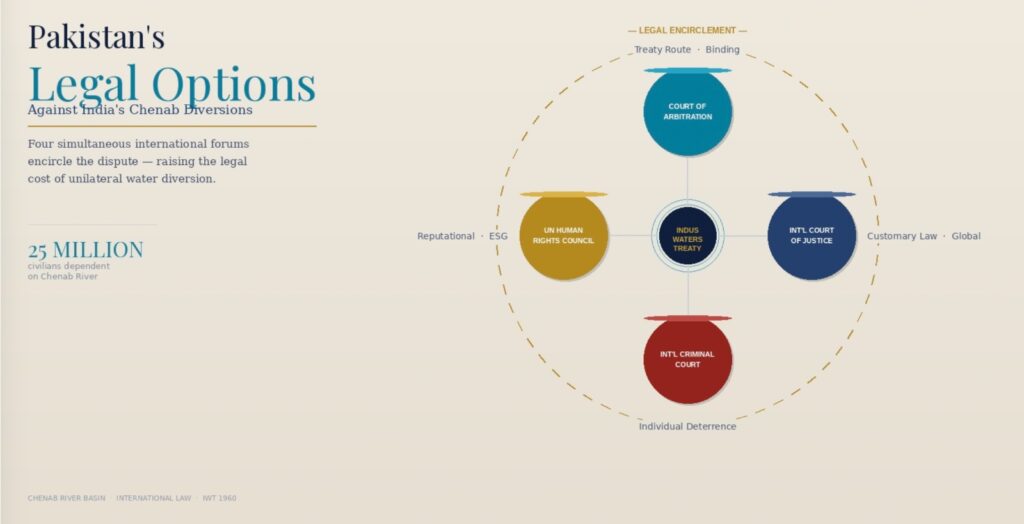
International law offers Pakistan at least four forums. Each has different rules, different remedies, and different political leverage. Filing simultaneously across all four is a high-risk, but if done meticulously, a high-reward strategy. Here’s how each option works.
- Court of Arbitration under the Indus Waters Treaty – “The Treaty Route”
The forum: Article IX of the IWT provides a 3-step dispute process: 1) Permanent Indus Commission, 2) Neutral Expert, 3) Court of Arbitration “CoA”. Pakistan has already used CoA twice: Baglihar 2007 and Kishenganga 2013.
The case: Pakistan would argue that India’s diversion tunnels violate IWT Annexure D, which limits storage and restricts designs that can “affect the flow” to Pakistan. If the tunnels transfer water out of basin without return, Pakistan can claim breach of Art III(2) “India shall let flow” and Annexure E on agricultural use.
Legal advantage: This is the strongest legal case. Both India and Pakistan are treaty parties. CoA decisions are binding. The 2013 Kishenganga award forced India to maintain minimum flows and modify dam design. The tribunal understands the technical details of run-of-river projects.
Political advantage: It keeps the dispute within the IWT framework India has defended for 65 years. If India refuses CoA jurisdiction, it damages IWT credibility. If India participates and loses, it must comply or face diplomatic costs.
Limitation: CoA only applies IWT, not broader environmental or human rights law. Remedies are limited to modifying/compensating the project. CoA cannot award damages for past harm and cannot stop construction unless Pakistan gets interim measures, which are hard to obtain.
- International Court of Justice – “The Customary Law Route”
The forum: ICJ hears disputes between states based on treaties, customary law, and general principles. Pakistan could file under ICJ jurisdiction if India consents, or use a compromise clause in another treaty.
The case: Since India hasn’t ratified the 1997 UN Watercourses Convention, Pakistan would rely on customary international law and Berlin Rules 2024: the “no-harm rule” from ‘Trail Smelter Arbitration 1941’ and “equitable and reasonable utilization” from ‘Gabčíkovo-Nagymaros 1997’. ICJ has called these principles customary. Pakistan would argue India is causing “significant transboundary harm” and “disrupting existing use” by diverting water indispensable for civilian survival, violating the duty to notify/consult, and breaching the principle of good faith.
Legal advantage: ICJ can interpret customary law for the whole world, not just the Indus basin. A judgment that basin-wide diversion violates customary law would set precedent for China-India Brahmaputra disputes and others. ICJ can order cessation of wrongful acts and reparations under Art 34 of its Statute.
Political advantage: ICJ cases get global media attention. They frame the issue as “rule of law vs unilateralism” rather than India-Pakistan bilateralism. Even if India doesn’t appear, ICJ can issue a judgment, creating legal stigma.
Limitation: ICJ jurisdiction requires consent. India withdrew general compulsory jurisdiction in 2019. Pakistan would need a specific compromissory clause or ad-hoc agreement, which India is unlikely to give. ICJ proceedings take 4-7 years. ICJ has no enforcement army — compliance depends on UN Security Council, where India has allies.
- International Criminal Court – “The Deterrence Route”
The forum: ICC Prosecutor’s Office receives communications from victims/states under Article 15 Rome Statute. Pakistan ratified Rome Statute in 2012; India did not.
The case: Pakistan cannot prosecute “water theft” as a standalone crime. It would have to fit facts into ICC crimes: 1) War crime Art 8(2)(b)(xxv) “starvation as method of warfare” — requires proof of armed conflict + intent to starve civilians; 2) Crime against humanity Art 7(1)(k) “inhumane acts” — requires widespread attack on civilians pursuant to state policy. The communication would allege that diversion is motivated by “political and military domination” and will cause malnutrition, crop failure, and water shortages for 25 million civilians.
Legal advantage: ICC threat is unique because it targets individuals, not states. Senior officials, project engineers, or ministers who order diversion could theoretically face arrest if they travel to 125 Rome Statute member states. Statements of Mr Narendra Modi and other high ranking Indian officials are on record already. Office of the Prosecutor’s (OTP) 2016 Policy Paper says it will prioritize environmental destruction causing displacement/livelihood loss.
Political advantage: “ICC investigation” headlines create chilling effect. International engineering firms, insurers, and lenders hate ICC risk. When Sudan’s Bashir was indicted, foreign investment collapsed. Even a preliminary examination forces companies to do due diligence on “complicity in alleged crimes”.
Limitation: Threshold is extremely high. OTP has never opened investigation for water diversion alone. It requires armed conflict nexus for Art 8, and “widespread attack” for Art 7. India’s non-membership means ICC can only act if crimes occur on Pakistan territory and are committed by persons whose conduct has territorial link. No individual has been named yet. ICC cannot order India to stop projects.
- UN Human Rights Council – “The Norms & Shaming Route”
The forum: HRC through Special Rapporteur on Right to Water + Universal Periodic Review (UPR). Both India and Pakistan are HRC members and party to International Covenant on Economic, Social and Cultural Rights ICESCR.
The case: File an “allegation letter” claiming violation of right to water under UN General Assembly (UNGA) Res 64/292 and ICESCR General Comment 15. Argue India’s extraterritorial acts deprive Pakistani civilians of water for drinking, sanitation, and food. Request HRC to: 1) send questions to India, 2) include issue in India’s 2027 UPR, 3) recommend minimum flows + EIA + consultation.
Legal advantage: Lowest legal threshold. No “armed conflict” needed. Right to water applies in peacetime. HRC can cite India’s own ICESCR obligations. The process allows victim statements from farmers, women, health officers — making abstract law human.
Political advantage: This is where “law meets politics”. UPR recommendations are debated by 193 states on livestream. If 40 countries tell India “protect downstream water rights”, it creates reputational cost. HRC reports are cited by World Bank, ADB, ESG rating agencies. For a country seeking $100B in FDI and “Brand India” status, HRC censure matters.
Limitation: HRC cannot issue binding orders or compensation. India can “note” rather than “accept” recommendations. Impact depends on sustained NGO pressure and media coverage.
The Multiplier Effect: Why “Simultaneous Filing” Matters
No single forum can solve this. But Pakistan can use all four together to create “legal encirclement”:
Legal narrative control: CoA says “you broke the treaty”. ICJ says “you broke customary law”. ICC says “your officials may face individual liability”. HRC says “you violated human rights”. Four different legal languages saying the same thing: unilateral diversion is unlawful. That narrative makes it harder for India to claim “technical/energy project only”.
Deterring global business: This is the most practical lever. Major construction on Chenab needs: European turbine makers, Korean/Chinese EPC contractors, international insurers, World Bank/ADB financing.
- CoA/ICJ risk: If Pakistan wins, India may have to pay compensation or modify design. Insurers factor that into premiums.
- ICC risk: Compliance officers at Siemens, ABB, SNC-Lavalin must now ask: “Could our engineer be named in an ICC communication?” Banks apply “enhanced due diligence” when ICC risk appears.
- HRC/UPR risk: ESG funds exclude companies complicit in human rights violations. 2027 UPR recommendations can trigger OECD National Contact Point complaints against firms.
India’s 2025 plan to hold IWT “in abeyance” already spooked investors. Adding ICC + HRC pressure makes lenders demand “human rights + transboundary water covenants” in loan agreements. Projects become slower and costlier.
Diplomatic leverage: When Pakistan files in four forums, third countries must take positions. US/EU may push India back to CoA to avoid ICJ/ICC escalation. China, sharing Brahmaputra with India, has interest in strong “no-harm” customary law. Gulf states dependent on food imports care about Pakistan’s agricultural stability. Pakistan converts a bilateral dispute into a multilateral rule-making moment.
Domestic legitimacy: For Pakistani public, seeing government “fight in every court” builds confidence that water rights are being defended legally, not just rhetorically. That reduces pressure for kinetic responses.
Law as Deterrence, Not Magic
None of these forums will turn off a tunnel overnight. Law is slow. But law shapes incentives. The goal isn’t just to “win a case” — it’s to raise the cost of unilateralism until India prefers negotiation.
Pakistan’s strongest immediate path remains IWT CoA, because it’s binding and technical. ICJ adds customary law weight for the long term. ICC adds individual deterrence even if prosecution is unlikely. HRC adds global normative pressure and directly impacts investors.
By filing simultaneously, Pakistan signals: “We will use every legal tool to protect civilian water rights.” That signal alone can make a German engineering firm think twice before bidding on a diversion tunnel, or make a Singapore bank demand extra clauses before lending. In 21st century water conflicts, legal risk is becoming as powerful as military risk.
The Indus basin is a test case. If law fails here, “water war” stops being metaphor and becomes policy. If law succeeds, it proves that even unequal states can use courts to protect 25 million farmers who just want water to grow wheat. That’s worth the effort of four filings.
The writer is an expert in transboundary waters and water resources management. He can be accessed at [email protected] and at X @shahjijr