 BeNewz
Related Articles
Aftab Maken
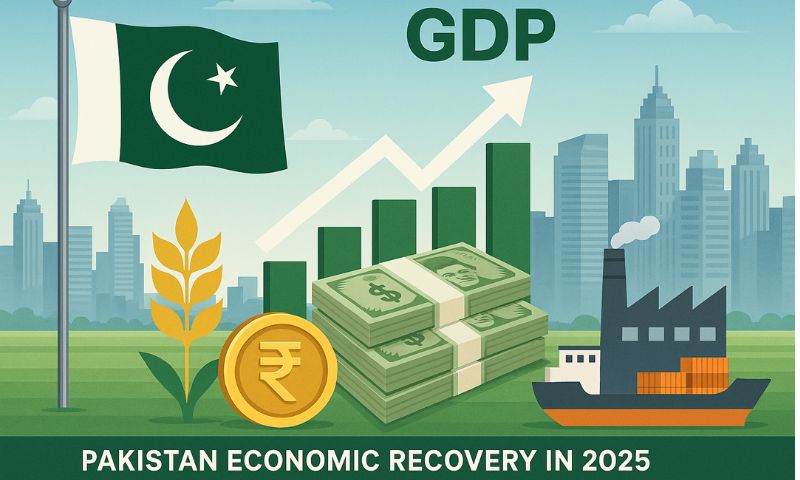
ISLAMABAD: Pakistan’s economy demonstrated notable signs of recovery in fiscal year 2025, driven by strong macroeconomic fundamentals, declining inflation, and a solid current account surplus. The Ministry of Finance’s latest Monthly Economic Update & Outlook reported a real GDP growth of 2.68%, closely aligned with the government’s projection of 2.7% growth for FY25, slightly revised down from the initial 3.6% target due to global and domestic challenges.
Inflation showed a significant decline, with the consumer price index (CPI) inflation falling to 3.5% in May 2025 from 11.8% in the same month last year, reflecting improved price stability supported by easing global commodity prices and targeted government policies. The State Bank of Pakistan (SBP) maintained the policy rate at 11% in June 2025, balancing inflation risks and regional uncertainties, with inflation expected to remain between 5% and 7% in FY2026.
Fiscal discipline improved markedly, with the fiscal deficit dropping to 3.2% of GDP during July-April FY2025 from 4.5% a year earlier. The government achieved a primary surplus of Rs 3.6 trillion (3.2% of GDP) as revenue growth outpaced expenditures, driven by a 44.4% surge in total federal receipts, including a 68.1% rise in non-tax revenue and a 25.9% increase in tax collection.
The agriculture sector showed positive momentum with an ambitious cotton production target of 10.18 million bales for the Kharif season 2025–26, cultivation over 2.2 million hectares, and a 15.7% increase in agricultural credit disbursement to Rs 2.07 trillion. Agricultural mechanization also advanced, with machinery imports rising 10% to $69.2 million and significant increases in urea and DAP fertilizer offtake.
Large-Scale Manufacturing (LSM) had mixed results: a 2.3% year-on-year growth in April 2025 but a 3.2% month-on-month contraction. Cumulatively, LSM contracted 1.5% during July-April FY2025, though key industries like textiles, apparel, beverages, and pharmaceuticals performed well. The automobile sector saw a remarkable turnaround with car production up 39.2%, trucks and buses 94.8%, and jeeps and pickups 74.7%. Cement dispatches increased 25.7% in exports despite a slight dip in domestic sales.
A major highlight was the $1.81 billion current account surplus in FY2025, reversing the $1.6 billion deficit from the previous year. This was largely fueled by a 28.8% surge in remittances, totaling $34.9 billion, with significant inflows from Saudi Arabia and the UAE. Exports of goods rose 4% to $29.7 billion, boosted by strong performances in knitwear, garments, bedwear, and an 18.7% jump in IT exports to $3.5 billion. The service sector exports grew by 8.5%.
The government enhanced social support through interest-free loans and the Benazir Income Support Programme (BISP), disbursing over 3 million loans since 2019. Overseas employment registrations increased by 12.7% in May 2025, reflecting growing emigration.
Looking ahead to FY2026, Pakistan’s economic outlook remains optimistic, supported by stabilized inflation, rising remittances and exports, and a doubling of private sector credit to Rs 832 billion. Continued reforms in tax policy, energy pricing, privatization, and environmental sustainability are expected to foster inclusive and sustainable growth.