 BeNewz

Related Articles


Aftab Maken
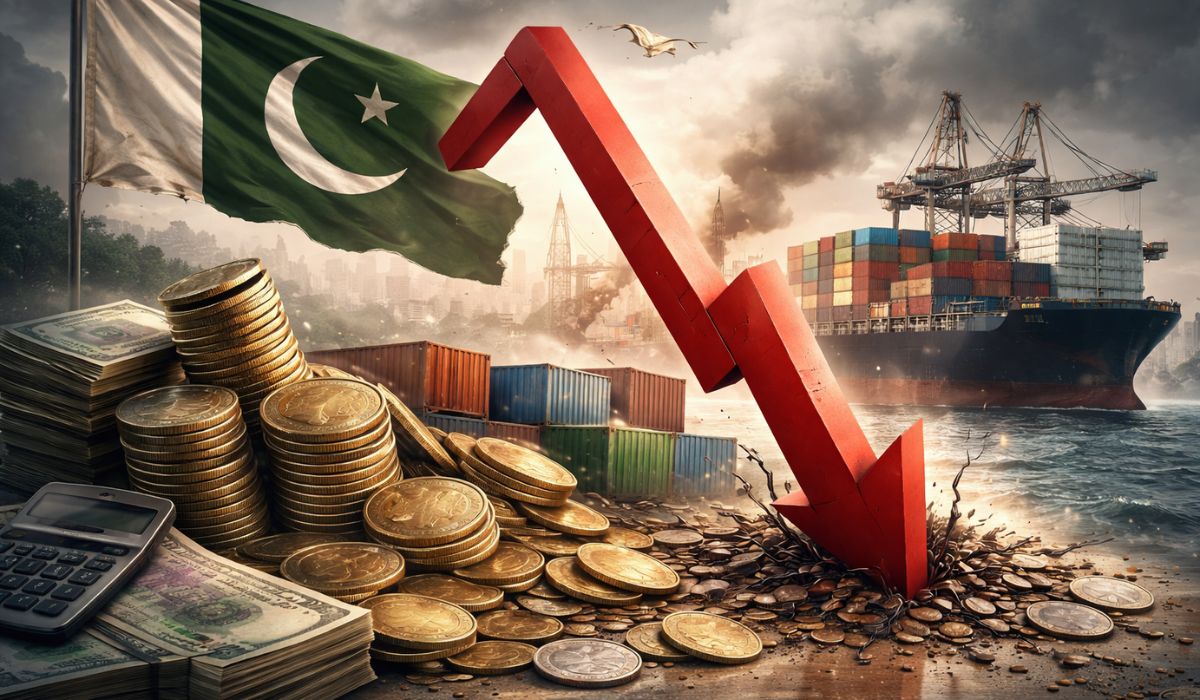
ISLAMABAD: Pakistan’s merchandise trade deficit widened significantly to $3.705 billion in December 2025, marking a 23.8% increase from $2.993 billion in the same month the previous year, according to provisional data released by the Pakistan Bureau of Statistics (PBS).
The deterioration was driven primarily by a steep 20.4% year-on-year drop in exports, which fell to $2.317 billion from $2.911 billion in December 2024. Imports, meanwhile, edged up 2% to $6.022 billion, compared to $5.904 billion a year earlier. On a month-on-month basis, the trade gap expanded by 28% from November’s $2.886 billion deficit, as imports rose 13.5% while exports declined 4.3%.
The PBS summary highlighted mixed trends. In rupee terms, December exports stood at Rs. 649.608 billion, down 4.4% from November but down 19.8% year-on-year. Imports reached Rs. 1,690.397 billion, reflecting a 13.3% monthly increase and a modest 2.9% annual rise.
For the first half of fiscal year 2025-26 (July-December), the cumulative trade deficit ballooned 34.6% to $19.204 billion from $14.271 billion in the corresponding period last year. Exports during this period dropped 8.7% to $15.184 billion, while imports surged 11.3% to $34.388 billion.
This widening gap underscores persistent structural challenges in Pakistan’s external sector, including sluggish global demand for key exports like textiles, rising production costs, and heavy reliance on imported energy and machinery.
Economists attribute the export slump to factors such as high energy prices, elevated borrowing costs, and competitive pressures from regional peers. Despite some bright spots—such as a 24% surge in seafood exports to China in the January-November period—the overall decline has raised alarms about pressure on foreign exchange reserves and the current account.
The current account posted a $812 million deficit in the first five months of FY26, reversing a $503 million surplus from the prior year. Analysts warn that sustained export weakness could strain balance-of-payments stability, even as macroeconomic indicators like inflation and reserves have shown improvement under recent reforms.
Government officials remain optimistic, pointing to efforts to diversify exports and attract investment. However, calls are growing for urgent measures to curb non-essential imports, reduce input costs for exporters, and enhance competitiveness. The PBS noted that final figures may adjust slightly due to rounding and pending data from certain agencies.
As Pakistan navigates these trade headwinds, policymakers face the challenge of balancing import-driven growth with export revival to achieve sustainable economic recovery in 2026.