 BeNewz

Related Articles



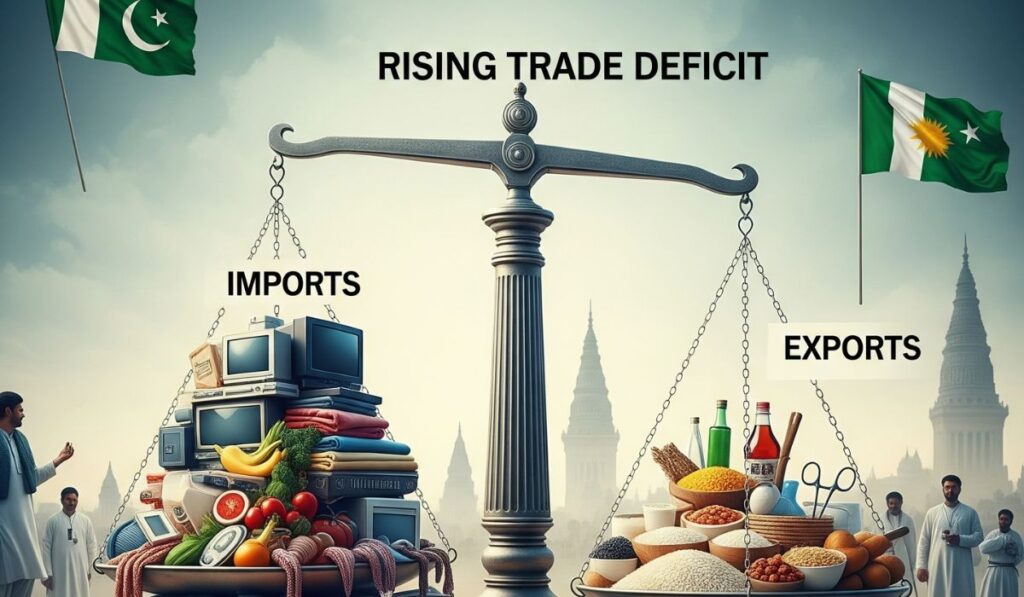
Exports rise over 12% as imports decline, improving the monthly trade balance significantly.
BeNewz Report
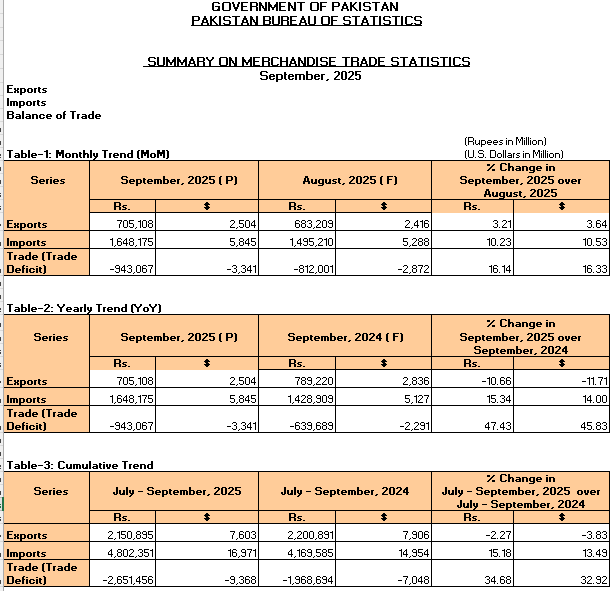
Pakistan’s trade deficit witnessed a notable contraction in September 2025, driven by a rise in exports and a significant reduction in imports, according to the latest figures released by the Pakistan Bureau of Statistics. The country recorded exports worth $2,875 million in September, marking a 12.36% increase compared to $2,558 million in August 2025. Meanwhile, imports dropped by 8.69% month-on-month, falling from $4,370 million to $3,990 million.
As a result, the trade deficit for the month stood at $1,115 million, significantly lower than the previous month’s gap of $1,812 million—an improvement of 38.46%. This marks one of the sharpest monthly improvements in the balance of trade for Pakistan this year, suggesting early signs of a shift toward more sustainable external sector dynamics.
On a year-on-year basis, the data also reveals a favorable trend. Exports in September 2025 grew by 1.15% compared to $2,842 million in September 2024. Imports fell by 9.03% from $4,387 million in the same period last year. Consequently, the trade deficit narrowed by 22.97% compared to September 2024, when the deficit stood at $1,545 million.
This positive development comes amid ongoing macroeconomic reforms and a gradual stabilization in the rupee-dollar exchange rate. Economic analysts attribute the surge in exports to increased global demand for Pakistani textiles and food commodities, along with improved port logistics that had been disrupted in earlier months due to regional tensions.
The reduction in imports is seen as a result of both tighter import regulations and a reduced domestic demand for machinery and luxury items. The government has recently intensified its policy of curbing non-essential imports to manage the current account deficit and preserve foreign exchange reserves.
Looking at the cumulative figures for the first quarter of the fiscal year 2025-26 (July to September), exports totaled $8,413 million, reflecting a 1.02% growth compared to the same period last year. Imports over the same three-month period stood at $12,755 million, showing a decrease of 5.89% from the previous year. The overall trade deficit for Q1 FY26 thus came to $4,342 million, down 14.53% year-on-year from $5,079 million recorded in Q1 FY25.
The narrowing trade gap is a welcome sign for economic managers as the country seeks to negotiate the next tranche of its loan program with the International Monetary Fund (IMF). A reduced trade deficit contributes to a healthier current account, which is a key metric under IMF assessments. It also relieves pressure on the State Bank of Pakistan’s foreign reserves, which have remained under strain due to debt repayments and limited inflows.
However, experts caution that while the short-term trend is encouraging, sustainable improvement will depend on structural reforms, export diversification, and easing global commodity prices. They highlight the need for long-term strategies to boost high-value exports such as IT services and engineered goods, along with reducing reliance on imported energy products.
In recent years, Pakistan has taken steps to diversify its export basket and explore new trade partnerships, particularly within the Gulf and Central Asian regions. If these efforts materialize effectively, they could help reduce the country’s vulnerability to external shocks and global demand fluctuations.
As Pakistan prepares for the winter energy season, where import bills typically rise due to LNG and oil purchases, economic observers will be closely watching whether this downward trend in the trade deficit can be maintained.
The narrowing of the trade gap in September 2025 reflects cautious optimism for Pakistan’s external sector. With sustained policy efforts and favorable global market conditions, the country may be on a gradual path toward improving its trade balance and strengthening its macroeconomic fundamentals.