 BeNewz

Related Articles



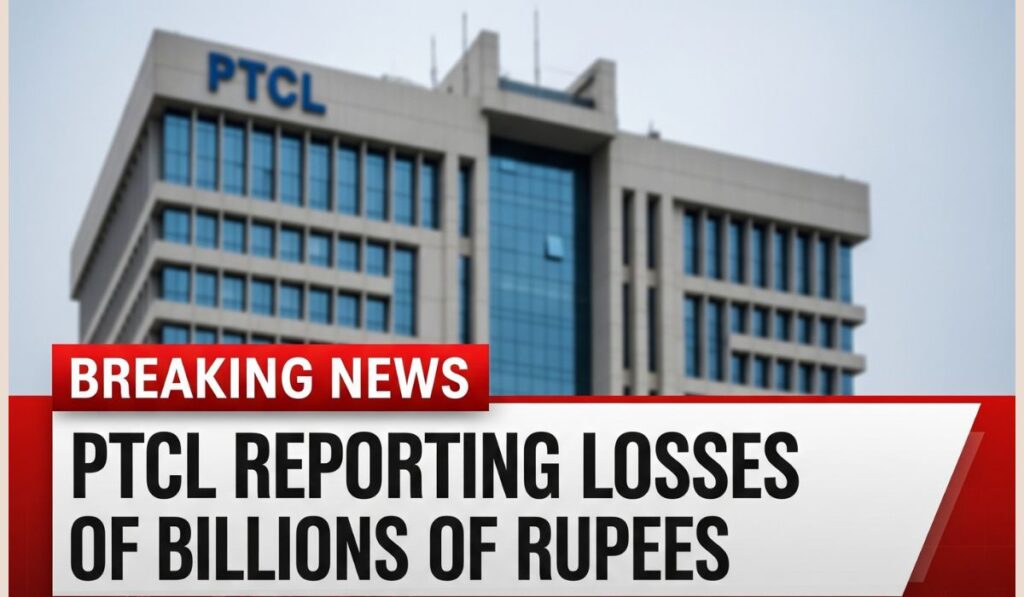
Losses mount despite top-line growth; Telenor deal adds to debt woe
Aftab Maken
ISLAMABAD: PTCL Group has posted a growth in consolidated revenues for FY2024, touching Rs 219.78 billion – up from Rs 188.66 billion last year – but the numbers tell only half the story. Beneath the surface, the company is grappling with escalating financial challenges, chronic losses, and a faltering profitability profile that raises red flags about its long-term sustainability.
Despite trimming its consolidated loss to Rs 14.39 billion from Rs 16.72 billion a year earlier, PTCL Group remains firmly in the red. And the bleeding doesn’t appear to be stopping anytime soon, says an official report of the Finance Ministry.
Core company profits cut in half
At the heart of the Group’s struggle is the parent entity, Pakistan Telecommunication Company Limited (PTCL). The company posted standalone revenue of Rs 107.77 billion – a 12% year-on-year jump. Yet, its net profit has nearly halved to Rs 4.82 billion from Rs 9.39 billion. This dramatic fall signals more than a temporary stumble – it’s symptomatic of deeper operational inefficiencies and structural issues.
Soaring finance costs, climbing employee-related liabilities, and mounting impairment losses on receivables have squeezed the company’s profitability. PTCL’s net margin shrank to a worrying 4.47% from 9.8% last year, highlighting how revenue gains are being offset by uncontrollable costs. The company continues to grapple with high energy expenses, inflated maintenance costs, and unchecked administrative overheads, all of which point to poor cost control.
Ufone – operational gains, financial strain
The Group’s cellular arm, Ufone, may be adding 4G subscribers and expanding network reach, but it’s bleeding cash to do it. Heavy capital expenditure on network expansion and spectrum acquisition, coupled with exposure to forex volatility due to dollar-denominated liabilities, has burdened Ufone’s balance sheet.
Worse still, competition from financially stronger rivals like Jazz and Zong is leaving little room for pricing power, pushing Ufone’s Average Revenue Per User (ARPU) into a tight corner. The result: operational gains not translating into bottom-line relief.
UBank’s credit risk shadow
UBank – the microfinance arm of the Group – posted a robust 65.7% year-on-year revenue jump. But its aggressive lending in economically vulnerable segments is raising eyebrows. With Pakistan’s economy in flux, the risk of rising non-performing loans (NPLs) looms large. If provisioning requirements rise sharply, UBank could shift from a revenue engine to a balance sheet liability.
Telenor acquisition – A high-stakes gamble
The Group’s much-touted plan to acquire Telenor Pakistan is being sold as a game-changer, potentially bringing 45 million new subscribers into the fold. But industry observers warn it could be a financial millstone.
The sheer scale of the acquisition – expected to be financed through a cocktail of debt and internal resources – risks over-leveraging PTCL Group’s already strained balance sheet. Integration challenges, ranging from tech compatibility to workforce alignment and customer retention, compound the risk. Any misstep could not only derail synergies but also disrupt core operations.
Debt pile-up and soaring finance costs
The Group’s finance costs surged to Rs 47 billion in FY2024, up from Rs 40 billion last year, driven by heavy borrowings in a high-interest environment. Long-term debt has reached Rs 104 billion, while short-term running finance rose to Rs 51 billion. Alarmingly, the current portion of long-term loans jumped more than fivefold – from Rs 25 billion to Rs 134 billion – signaling mounting pressure on short-term liquidity.
Cash flows, meanwhile, remain weak, and with rising interest rates and debt rollover risks, the Group is walking a financial tightrope.
Pension liabilities – a ticking time bomb
Adding to the financial strain are surging employee-related liabilities. Retirement benefit obligations climbed to Rs 42.65 billion, up from Rs 34.32 billion last year, highlighting the burden of an underfunded pension system. Any adverse ruling or investment shortfall could trigger sizable cash payouts, choking the Group’s already tight liquidity position.
Legacy burden, digital dream
While PTCL pushes to diversify into digital services, broadband fiber, and fintech, it remains anchored to its legacy fixed-line business – a segment in slow decline but still heavy on maintenance and costs. The slow uptick in higher-margin corporate and broadband revenue streams is not fast enough to plug the profitability holes elsewhere.
The bottom line
On paper, PTCL Group is expanding, investing, and growing revenues. But scratch the surface, and a bleaker picture emerges – one of a heavily leveraged company caught in a profitability squeeze, burdened by rising costs, weak margins, and aggressive expansion that risks outpacing its financial capacity.
As it gears up for its boldest move yet – the Telenor acquisition – the Group must tread carefully. Missteps at this juncture could trigger a financial spiral that even strong top-line growth may not rescue. FY2024 may be remembered not for revenue gains, but for the warning signs they masked.