 BeNewz

Related Articles



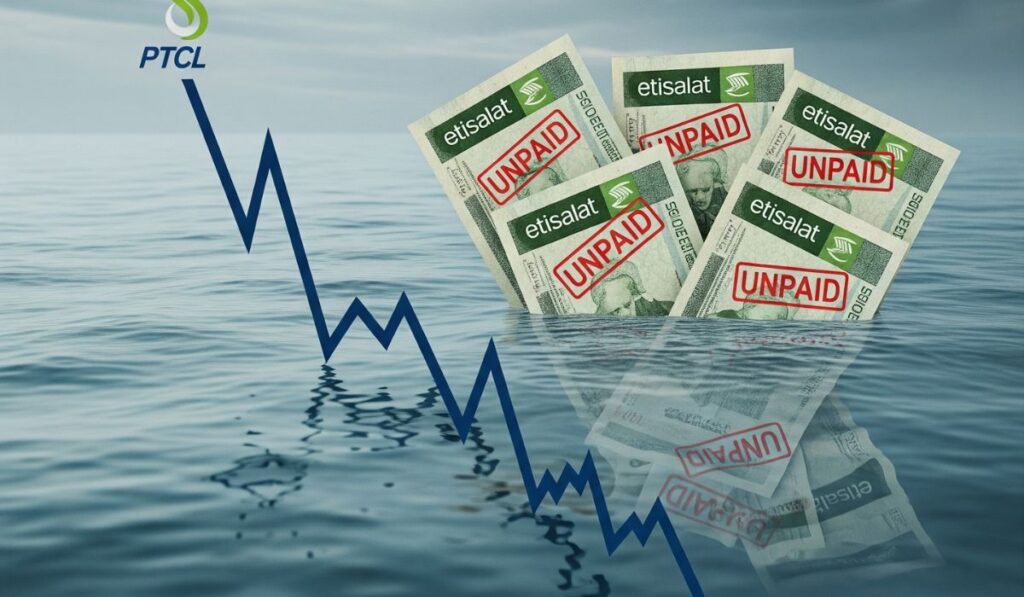
Pakistan Telecommunication Company Limited reported a Rs 9.90 billion half-year loss, exposing structural weaknesses, while $800m privatization dues from Etisalat remain unsettled.
Pakistan Telecommunication Company Limited (PTCL), once Pakistan’s telecom monopoly and still the largest fixed-line operator, has reported a massive consolidated loss of Rs 9.90 billion for the half-year ended June 30, 2025, a grim reminder of the company’s unresolved structural burdens and the long shadow of its troubled privatization. The loss, equal to Rs. 1.94 per share, is 11 percent higher than the Rs. 8.91 billion loss posted in the same period last year.
The setback was primarily caused by a one-time, non-cash past service cost of Rs. 5.89 billion linked to pension obligations. The legacy liability, booked under “Other costs,” completely wiped out the company’s operational gains, underlining PTCL’s long-standing struggle to balance rising revenues with crippling inherited expenses. Even on a standalone basis, excluding subsidiaries such as Ufone, the company swung into a loss of Rs. 3.26 billion (Rs. 0.64 per share), compared to a Rs. 1.14 billion profit in the same period last year.
While consolidated revenue rose 16.1 percent year-on-year to Rs. 124.6 billion, and standalone revenue climbed 11.8 percent to Rs. 58.91 billion, the gains were overshadowed by mounting costs. Operating profit before the pension hit stood at a healthy Rs. 7.86 billion, but the extraordinary charge pushed the bottom line into deep negative territory. No dividend was recommended by the board, further disappointing shareholders.
Market reaction remained subdued, with PTCL’s share price edging down by less than 0.5 percent, but analysts warned that investor indifference could turn into sharp sell-offs if structural issues remain unaddressed. “This isn’t just a bad quarter; this is a pattern,” a Karachi-based analyst told this publication. “PTCL has failed to reform its cost structure since privatization, and the pension obligations remain an albatross.”
The company’s financial deterioration is also tied to the unfinished business of its privatization nearly two decades ago. In 2005, 26 percent of PTCL’s shares and management control were sold to UAE-based Etisalat for $2.6 billion. However, nearly $800 million of the payment remains withheld due to disputes over the transfer of real estate properties. Successive Pakistani governments have failed to resolve the deadlock, leaving PTCL under partial foreign control without the full financial commitment of its majority shareholder.
Critics argue that Etisalat’s failure to clear its outstanding dues has weakened PTCL’s ability to restructure effectively, while also raising questions about the privatization model. “Etisalat took control, but Pakistan never got the full price,” said an Islamabad-based telecom expert. “It is a failure of both governance and corporate accountability, and PTCL continues to bleed as a result.”
PTCL’s operational struggles are compounded by fierce competition in the broadband and mobile markets, where private rivals have rapidly expanded customer bases and services. Despite revenue growth in broadband and enterprise solutions, PTCL remains bogged down by high costs, declining landline subscriptions, and unresolved pension liabilities.
The company’s persistent losses have reignited debate over whether privatization ever delivered the promised efficiency gains. With Etisalat still holding back nearly $800 million, and PTCL posting recurring losses despite growing revenues, skepticism is mounting over the future of the country’s once-flagship telecom company.
For shareholders and policymakers alike, PTCL’s trajectory underscores a broader challenge facing state-linked enterprises: rising costs, misaligned incentives, and the failure to enforce accountability in privatization contracts. Until the pension burden is resolved and Etisalat settles its long-standing dues, PTCL’s losses may continue to deepen, leaving both investors and customers questioning the company’s long-term viability.