 BeNewz

Related Articles


Aftab Maken
ISLAMABAD: Federal Minister for Power Awais Ahmed Khan Leghari has informed the National Assembly’s Standing Committee on Power that the country is suffering electricity theft of Rs 250 billion annually. He further said that K-Electric can now draw up to 600 MW from the national grid, bringing its total electricity availability to 2,000 MW.
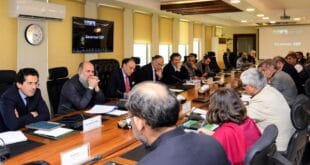
The committee meeting, chaired by MNA Muhammad Idrees, was briefed by HESCO officials, who said that any fault at the Jamshoro grid leads to a complete blackout across the entire HESCO network. A failure at the Jamshoro grid disrupts power supply to 13 cities of Hyderabad division.
Contradicting to the reply of HESCO officials, the federal minister said Jamshoro grid only goes offline during national blackouts. “I don’t recall any isolated incident of fault within the Jamshoro grid,” added the minister.
However, HESCO officials reiterated that past incidents had indeed occurred where faults at Jamshoro led to widespread outages other than HESCO region as well. They also requested the establishment of an alternative 220 kV grid station for HESCO, possibly connected through Matiari or Nawabshah.
Committee member Syed Waseem Hussain added that even Karachi is affected when faults occur at the Jamshoro grid.
Minister Leghari dismissed this claim of Syed Wasim by stating, “Jamshoro grid has no connection with K-Electric. Its system is entirely separate.”
Updating the Committee on K-Electric’s integration with the national grid, K-Electric officials informed the committee that the utility has established four interconnection points with the national grid, with a combined capacity exceeding 2,000 MW.
The KE official further said that two major grid stations — the 500 kV KKI grid and the 220 kV Dhabeji grid — have been successfully energized. Under an interim arrangement, the KKI grid is currently drawing up to 1,600 MW from the NTDC network.
A new connection point is under construction between K2/K3 and PQEPCL, linked via a 500 kV NTDC transmission line. This line is expected to be completed by the end of July 2025, they added.
Once fully constructed and integrated with the KKI grid, K-Electric’s drawdown capacity from the national grid is projected to reach approximately 2,100 MW. However, K-Electric officials clarified that this enhanced capacity depends on regulatory approvals from NEPRA and completion of technical feasibility studies.
The officials further said K-Electric’s integration with the national grid is a critical step toward ensuring a more stable electricity supply to Karachi.
However, the minister further clarified that K-Electric can now receive up to 600 MW from the national grid, which will increase its capacity to 2,000 MW. “We will first prepare a report to assess the need for an alternate grid,” he said.
Providing new connections, he added, would boost consumption. “Higher electricity usage will lead to lower rates. The current high cost of power is due to underutilization.”
Committee member Rana Sikandar Hayat urged for new connections in housing societies to increase consumption. Power Minister, Awais Leghari responded, “That benefits the power sector, but comes at a national cost. If authorities issue demand notices, we’ll install the connections.”
He emphasized, “Power theft is not Rs 500 billion as claimed — it’s Rs 250 billion annually.”
Rana Sikandar Hayat added that the remaining amounts are due to unpaid bills. MNA Malik Anwar Taj raised public concerns regarding excessive billing when usage crosses the 200-unit threshold. He demanded the committee include this issue in the agenda.
“Why does the bill spike so drastically for just one extra unit?” he asked.
Energy Minister Awais Leghari stated that consumers using up to 200 units of electricity are being given an 80% discount. We will take further steps to provide relief to consumers.
In the meeting, NTDC officials briefed the Power Committee, saying that a study with HESCO was recently conducted. A new grid is under construction at a special location, and augmentation work is ongoing at Khan Pahalla Road, Jamshoro, and other places. New transformers are being installed.
Officials stated that blackouts in 2020 and 2021 across the country were due to the complete shutdown of the Jamshoro station. Currently, four transmission lines from Jamshoro are online: K-2, K-3, Chinese projects, and Matiari. All local generation is being supplied to K-Electric and other institutions. The system is fully integrated.
They further said that a new grid station in Mirpurkhas is under construction by NGDC and will be completed by 2026. This grid will be connected to the transmission lines from Tando Muhammad Khan and Jamshoro. Construction of the line has already started.
The foundation work of C-towers is complete, and the project will be energized next year. Once completed, this will fully meet HESCO’s demand. Currently, there is no additional need for MBC, SXC, or SFC. Matiari is our main conversion station, where ten transmission lines terminate, and electricity is supplied to the north through HVDC conversion.
They noted that until a full grid or transformer is built in Matiari, it’s not possible to extract new lines from there. New value stations or lines are only constructed when studies or load forecasts justify them. This is also the strategy from an investment perspective. If HESCO or SO require more engineering development, we are ready to review the study and form a joint strategy.
NTDC officials confirmed that at present, there is no need for additional augmentation or new lines.
PESCO officials briefed the National Assembly Power Committee and said that PESCO receives electricity from its generation quota. Their normal demand ranges between 1250 and 1300 MW, and their quota is based on daily generation. Currently, PESCO receives only 5.5% of the total generation.
They explained that this 5.5% share is provided through local powerhouses or local distribution. Due to the small quota, their demand is not fully met.
The issue of expensive electricity and high bills echoed in the Standing Committee on Energy. Committee member Rana Sikandar Hayat asked what response they should give to the people—when will electricity become cheaper? He said that many informal settlements and housing societies still have no electricity connections.
Rana Sikandar Hayat said that some societies have existed for 50 years without electricity. In such areas, power theft is rampant—one meter supplies electricity to 10 illegal connections.
The energy minister responded that connections are only provided in housing areas when the local authority demands them. If the authority requests, we are obligated to provide connections. Until then, we cannot play the role of the authority.
Awais Leghari said that it is easy for him to provide connections—more connections mean more electricity usage, and greater usage will bring down rates. Electricity is expensive only because its consumption is low.