 BeNewz

Related Articles



Aftab Maken
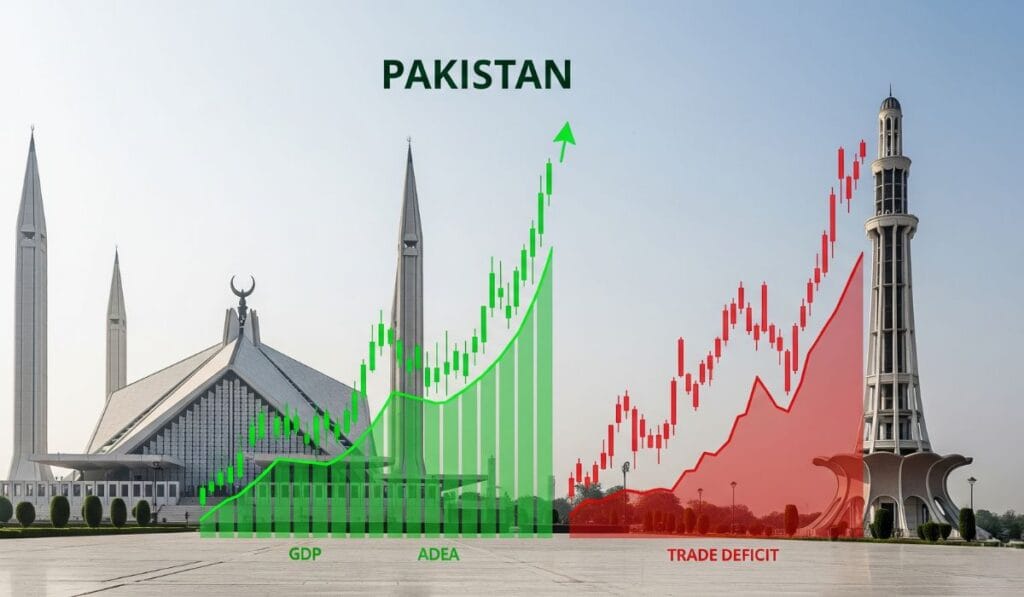
ISLAMABAD: While a recent government report heralds a period of remarkable economic recovery for Pakistan, a closer look at the data reveals some underlying challenges that could temper the celebratory mood. The July 2025 “Economic Update” from the Finance Division, while celebrating a historic current account surplus and a sharp drop in inflation, also points to a widening trade deficit and other potential risks that require careful monitoring.
The report notes a significant milestone: the first annual current account surplus in 14 years, amounting to $2.1 billion. This impressive turnaround was driven by a robust 26.6% increase in workers’ remittances and a 4.2% rise in exports of goods. However, this success masks a more concerning trend in the balance of trade. For the fiscal year 2025, imports surged by 11.1% to $59.1 billion, outpacing the growth in exports and leading to a widening trade deficit of $26.8 billion—an increase from $22.2 billion the previous year. This suggests that while external funds from remittances and services were crucial in achieving the surplus, the country’s reliance on imports remains a significant vulnerability.
Further complicating the picture is the performance of the Large-Scale Manufacturing (LSM) sector. Despite a promising month-on-month recovery in May 2025, the cumulative output for the July-May period saw a 1.2% decline. This indicates that the industrial sector is still facing headwinds and has not fully recovered from the challenges of the previous year.
Additionally, the report reveals a notable outflow of foreign portfolio investment (FPI). While foreign direct investment (FDI) saw a modest increase, both private and public FPI recorded net outflows, totaling over $650 million. This suggests that some foreign investors, particularly those in the capital markets, are less confident about the country’s long-term prospects. This stands in contrast to the bullish sentiment of the domestic stock market and the positive narrative of the economic update.
The economic outlook is also not without its risks. The report cautions that “recent heavy rains may affect agricultural yields and supply chains,” a potential threat to the much-anticipated rebound in the agriculture sector. Furthermore, the global economic landscape, as described in the report, is fraught with its own challenges. Persistent inflation concerns, restrictive trade policies, and geopolitical tensions are all cited as potential downside risks that could impact Pakistan’s export market and economic stability in the coming year.
While the government’s efforts to contain the fiscal deficit and manage inflation are commendable and have led to significant short-term gains, these underlying issues highlight the fragility of the recovery. The widening trade deficit, coupled with negative signals from certain economic sectors and external risks, suggests that policymakers must remain vigilant to ensure that the current momentum translates into sustainable, long-term economic prosperity for Pakistan.