 BeNewz

Related Articles


Only Rs45.5 million recovered so far, as the majority of fines are challenged or pending; fatal accidents dominate enforcement action.

Aftab Maken
NEPRA–a regulator in Pakistan’s power sector companies, including distribution giants like K-Electric and national transmission operator NTDC, has fined a total of Rs 975 million for fatal and non-fatal workplace accidents, yet just Rs 45.5 million has been deposited so far. The remaining penalties—over 95%—are currently being contested in courts or await execution.
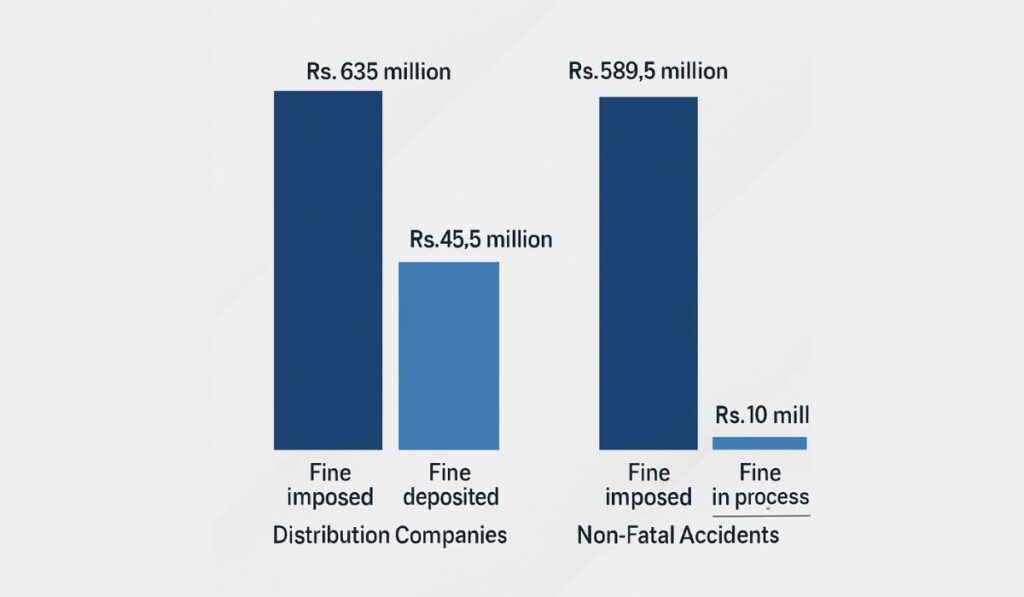
According to the latest summary of enforcement actions, regulatory authorities have imposed Rs635 million in fines on distribution companies, including KE, for incidents resulting in the deaths of line staff and field workers. However, only a small portion—Rs 45.5 million—has actually been recovered. The remaining Rs 589.5 million is either under legal challenge in appellate forums such as the National Electric Power Regulatory Authority’s (NEPRA) Appellate Tribunal (NAT) or pending judicial review in civil courts.
In cases involving non-fatal but serious injuries, Rs330 million in additional fines were levied on Ex-WAPDA Distribution Companies (XWDISCOs). To date, none of this has been deposited. All of these fines are under process, either facing internal review or a legal challenge initiated by the concerned DISCOs.
In a separate incident, the National Transmission and Despatch Company (NTDC) was fined Rs 10 million following a fatal accident, as per an order issued on February 26, 2025. Recovery of this amount is reportedly still underway.
These penalties stem from a series of safety violations across the power sector, where line workers routinely face life-threatening risks due to poor safety protocols, outdated equipment, and inadequate training. Fatal accidents are especially common during routine maintenance or emergency repairs, often involving high-voltage lines without proper deactivation or personal protective equipment.
Experts note that these figures highlight a troubling disconnect between regulatory enforcement and actual compliance. While the imposition of fines signals increased scrutiny by safety regulators, the inability to enforce collections points to systemic challenges in holding power utilities accountable.
Workplace safety has long been a concern in Pakistan’s energy sector, with annual reports consistently flagging high rates of fatalities and serious injuries among technical staff. Despite repeated calls from labor unions and safety advocates, institutional reform has remained limited, and compensation for victims or their families often falls short of expectations.
The slow recovery of fines also reflects broader issues in Pakistan’s legal and regulatory framework. Power companies frequently use legal recourse to delay or dilute penalties, while victims’ families face bureaucratic and legal hurdles in pursuing justice or reparations.
NEPRA and other oversight bodies have previously mandated safety audits, mandatory use of protective gear, and technical certifications for line workers. However, implementation has been uneven, particularly in remote or under-resourced regions where supervisory mechanisms are weak.
Moreover, the culture of reactive enforcement—where action is taken only after an incident—continues to dominate regulatory behavior, with limited emphasis on preventive safety standards or proactive risk assessment.
The situation poses reputational and operational risks to Pakistan’s power sector at a time when major reforms, including privatization and grid modernization, are underway. International development partners and financial institutions have stressed the importance of labor safety and operational compliance as prerequisites for sectoral funding and support.
As fatalities continue to occur despite repeated fines and advisories, the effectiveness of punitive action comes into question. Critics argue that unless enforcement leads to measurable changes in workplace practices, financial penalties alone serve little more than symbolic value.
The Rs975 million in fines represents more than just numbers—it is a stark reminder of the human cost of weak safety compliance and fragmented regulatory oversight. Unless Pakistan’s power companies address these root causes with urgency, the sector may continue to suffer both reputational damage and the irreparable loss of lives.