 BeNewz

Related Articles


Aftab Maken
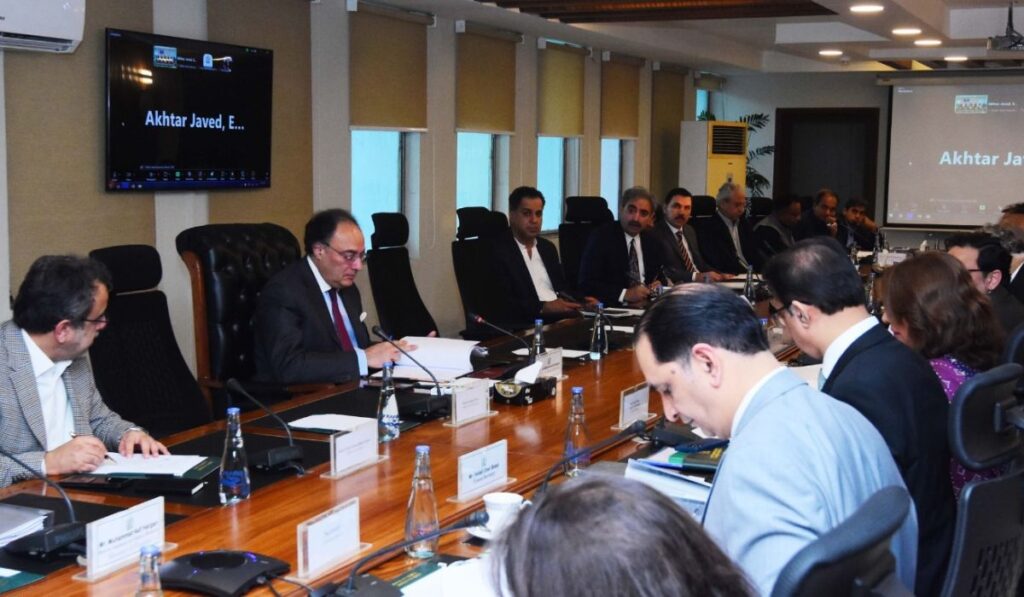
The Economic Coordination Committee (ECC), chaired by Finance Minister Muhammad Aurangzeb, is set to meet today (Friday) to deliberate on a key economic agenda focused on energy sector reforms, fiscal management, and industrial support measures.
According to the Cabinet Division’s notice, the ECC will consider seven major proposals submitted by the Power, Petroleum, Finance, and Maritime Affairs divisions. Among the top agenda items is the approval of a Rs659.6 billion government guarantee to support the power sector, along with tariff reforms for six nuclear power plants — Chashma C-1 to C-4 and Karachi K-2 and K-3 — aimed at reducing generation costs and ensuring pricing stability.
The Power Division has also sought a sovereign guarantee to help manage Rs1.225 trillion in circular debt financing, a move intended to stabilize the liquidity position of distribution companies and curb further debt accumulation.
The Petroleum Division has proposed a new gas allocation and pricing framework for the Mari gas field, which serves as a crucial supply source for fertilizer manufacturers. The reform is designed to ensure stable feedstock supply and improve cost efficiency for the agriculture-dependent fertilizer industry.
The Finance Division will present a plan to phase out existing home remittance incentive schemes and transition to a new framework, while the Ministry of National Food Security is expected to seek approval for reallocating funds to assist flood-affected communities and provide a standby contribution of 3,000 metric tons of wheat.
In addition, the ECC will review a proposal to allow Pakistan International Bulk Terminal (PIBT) at Port Qasim to handle exports of copper, gold, and other mineral commodities — a step expected to enhance mineral exports and open new revenue channels for the economy.
The ECC meeting comes at a critical time as Pakistan faces mounting fiscal challenges, including a ballooning energy sector debt and persistent external financing pressures. Economists say decisions taken today could significantly shape short-term policy on tariffs, gas pricing, and sector liquidity, influencing the government’s broader economic stabilization plan.