 BeNewz

Related Articles



Pakistan’s GDP growth forecast for 2025 holds steady at 2.5%, while inflation is projected to ease from 23.4% in 2024 to 4.5% in 2025, according to the ADB.
BeNewz Report
ISLAMABAD: The Asian Development Bank (ADB) has maintained its GDP growth forecast for Pakistan at 2.5% for 2025, while projecting a modest uptick to 2.7% for 2026, indicating a gradual economic recovery from the country’s ongoing macroeconomic challenges. The figures are part of the ADB’s Asian Development Outlook (ADO) published in September 2025, which also reports a significant decline in inflation expectations, down from a staggering 23.4% in 2024 to 4.5% in 2025.
The outlook signals a stabilizing economic trajectory after years of volatility marked by inflationary pressures, fiscal imbalances, and external sector vulnerabilities. The unchanged growth forecast for 2025 reflects a cautious optimism rooted in domestic reforms, fiscal consolidation efforts, and improving investor sentiment, albeit tempered by weak external demand and structural bottlenecks.
Pakistan’s inflation forecast shows a sharper shift. After peaking at 23.4% in 2024, inflation is projected to fall to 4.5% in 2025 before edging up to 5.8% in 2026. The 2025 revision is particularly noteworthy, as it suggests easing cost-of-living pressures for households and improved macroeconomic management. ADB’s earlier projection in April for 2025 had placed inflation at 6.0%, indicating a 1.5 percentage point downward revision in the latest update.
The ADB attributes the decline in inflation to lower global commodity prices, especially those of food and fuel, as well as tighter monetary policy. However, the bank warns that domestic vulnerabilities, including fiscal pressures and currency depreciation risks, could still affect medium-term price stability. The inflation outlook for 2026, revised downward to 5.8% from April’s 6.0%, further supports the expectation of a soft landing for Pakistan’s economy.
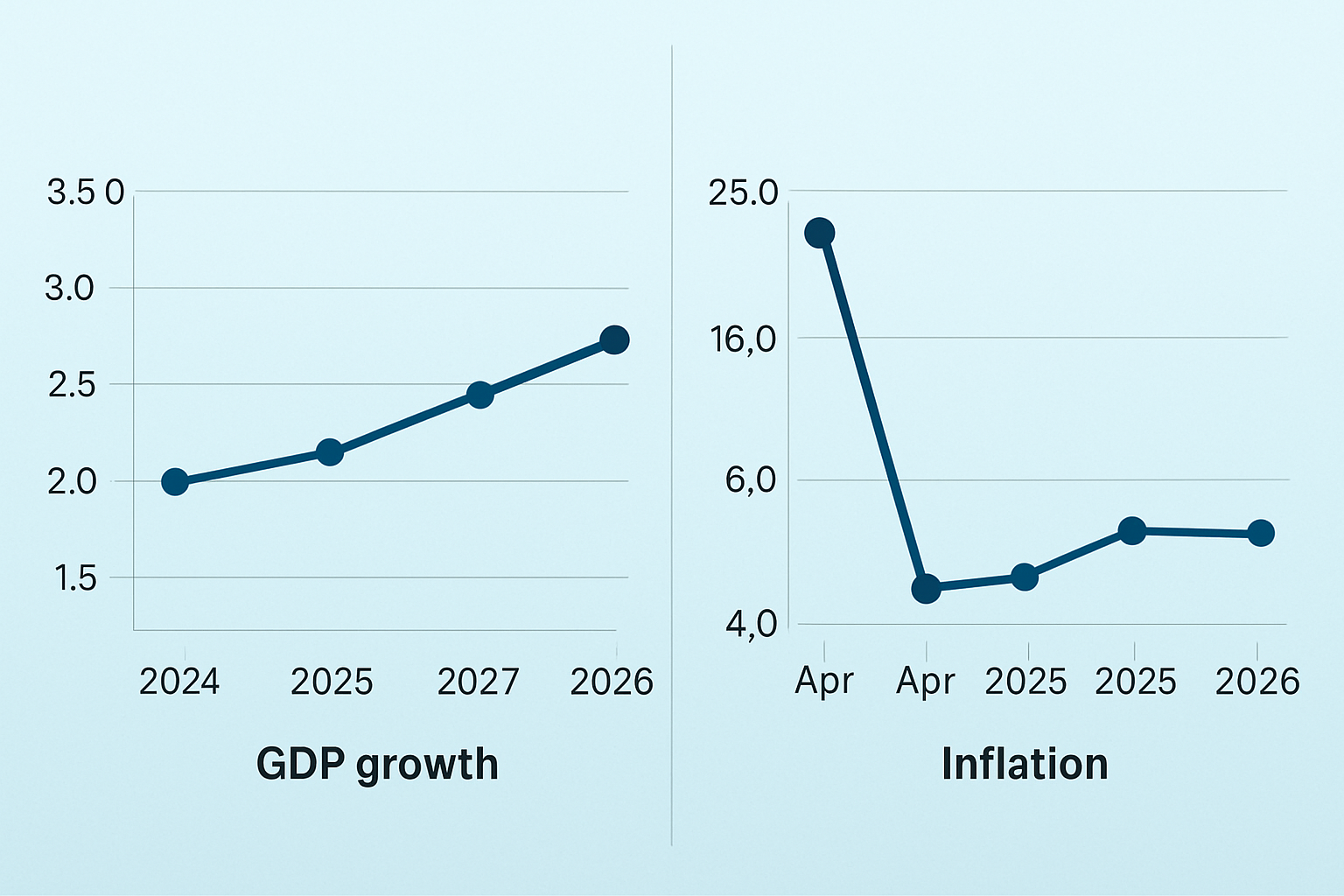
The growth forecast for 2024 was also steady at 2.5%, with no change between the April and September estimates. For 2026, the GDP growth projection has been slightly revised downward from 3.0% (April) to 2.7% (September), underscoring continued economic fragility and the need for deep-rooted reforms in taxation, energy pricing, and governance. Still, the projection suggests that a gradual return to economic momentum could occur by 2026 if stability measures remain on track.
The ADB report’s data for Pakistan is part of a broader regional assessment that saw downgraded forecasts for much of developing Asia due to high US tariffs, trade uncertainty, and uneven global demand. While larger economies like India and China have also seen downward revisions, Pakistan’s growth trajectory appears more vulnerable to domestic structural constraints than to external shocks alone.
ADB’s earlier assessments had flagged Pakistan’s economy as being under intense stress in 2023–24, primarily driven by high inflation, a severe balance of payments crisis, and multiple currency devaluations. However, a $3 billion short-term IMF program initiated in mid-2023 helped stabilize the economy and restore some market confidence, albeit temporarily. Pakistan is now expected to negotiate a longer-term IMF arrangement by early 2026, which could help anchor reforms and unlock further external financing.
In the near term, the ADB emphasizes the importance of maintaining tight fiscal discipline, ensuring central bank independence, and pursuing energy sector reforms to sustain disinflation and restore macroeconomic confidence. Political stability and policy continuity, particularly after the general elections expected in 2026, will also be key to ensuring economic recovery stays on course.
The ADB’s latest projections, though modest, offer a cautiously hopeful outlook for Pakistan’s economy. With inflation likely to ease significantly and growth expected to recover gradually, the economy could enter a period of stabilization—provided fiscal discipline, structural reform, and external financing remain consistent over the medium term.
Meanwhile, the ADB has trimmed its economic growth projections for developing Asia and the Pacific, citing the adverse effects of heightened US tariffs and persistent global trade uncertainty. The updated figures, released in the September 2025 edition of the Asian Development Outlook (ADO), forecast the region’s economies to expand by 4.8% in 2025 and 4.5% in 2026—down from April’s estimates of 4.9% and 4.7%, respectively.